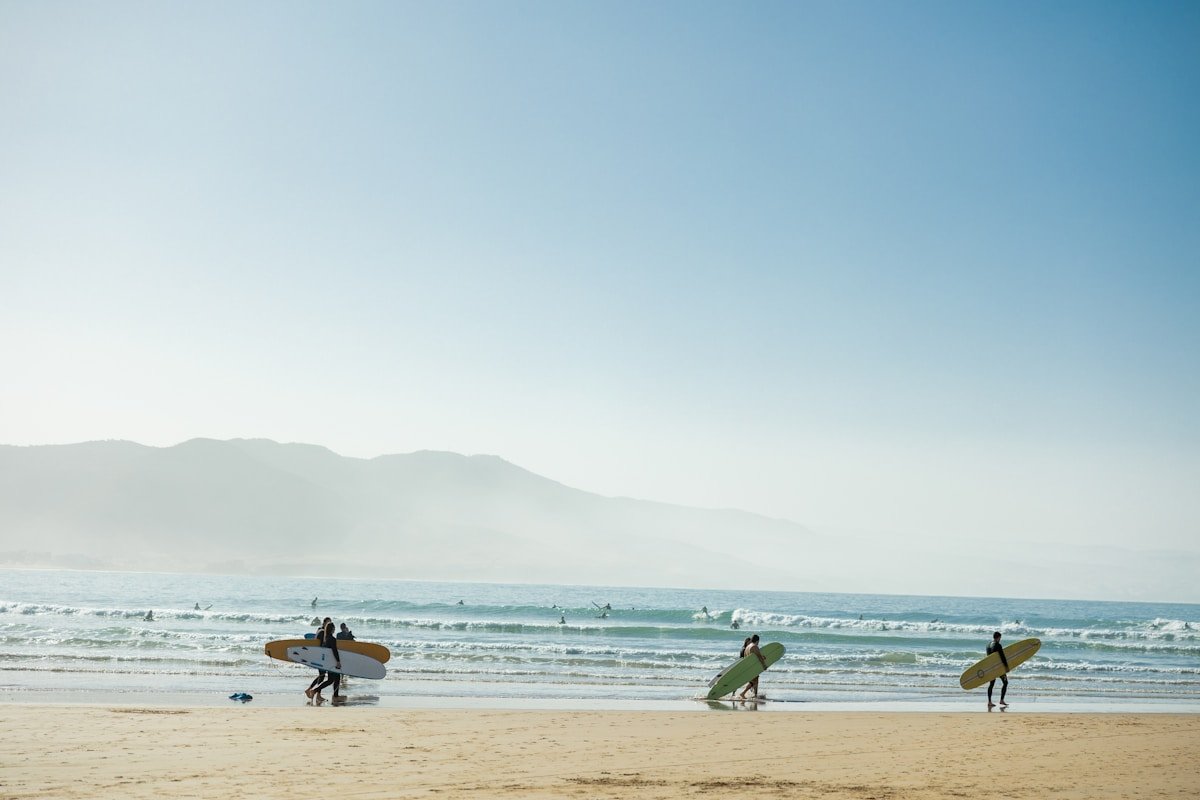
Seven days on Morocco’s Atlantic coast is enough to surf four distinct breaks, explore a small fishing village, eat well, and come back wanting more. This itinerary is built for surfers of beginner-to-intermediate level, with a budget range for each day and flexibility built in for those who want to push further or pull back. We’ve structured it around Taghazout as your base, with one overnight in a different location and one full day trip.
Before You Arrive
Fly into Agadir Al Massira Airport (AGA). Most European cities have direct connections via Ryanair, easyJet, Air Arabia Maroc, and Royal Air Maroc. Flight time from London, Amsterdam, Paris: 3–4 hours. From Madrid or Lisbon: 2–3 hours.
Book your accommodation in advance, particularly in peak season (November–January). A surf camp handles most of the weekly logistics - board, wetsuit, transport to the break, meals - and works well for first-time visitors. If you prefer more flexibility, a guesthouse in Taghazout village or Tamraght and hiring boards and lessons separately is equally viable. See the where to stay guide for full options.
Search hotels in Taghazout on Booking.com
What to bring: passport (no advance visa required for most EU, UK, US, Canadian passport holders as of 2026), a small daypack, sun protection (SPF50+), a rash guard, swimwear. The surf camp provides boards and wetsuits. See the packing list for the full breakdown.
If you plan to explore independently: Book a hire car at Agadir Airport in advance - pre-booking is cheaper than desk rates, and availability is limited in peak season (November–January).
Day 1: Arrive Agadir, Transfer to Taghazout
Morning/afternoon: Land at AGA. After baggage and arrival, take a grand taxi north to Taghazout. The journey takes approximately 15–25 minutes depending on traffic. In a shared grand taxi (you’ll share with up to five other passengers, often waiting briefly at the taxi rank for the car to fill), the fare is approximately 15–25 MAD per person. A private petit taxi or pre-arranged transfer runs approximately 150–250 MAD.
Afternoon: Check in, get oriented. Taghazout village is small enough to walk in 15 minutes. Walk to Hash Point and look down at the wave - you’ll be surfing it (or watching others surf it) for the rest of the week. Walk the main street. Locate a cafe for mint tea.
Evening: First tagine. Restaurants in the village serve chicken or kefta tagine for approximately 50–80 MAD. The village streets in the evening are quiet and worth walking slowly.
Budget guide:
- Budget: 400–500 MAD (dorm, street food, shared taxi)
- Mid-range: 700–900 MAD (guesthouse double, sit-down dinner)
- Surf camp: included in weekly package
Day 2: First Surf Lesson at Panoramas
Morning: Your surf camp or school takes you by van to the beach. Panoramas is the standard beginner location - a right-hand break with a forgiving white water section that suits first lessons well. Two hours in the water: land drills first, then white water riding, then small unbroken waves by the end. Most people stand up on day one. Most people also fall off repeatedly. Both are correct. If you’re not in a surf camp, book a surf lesson through GetYourGuide — slots fill quickly in peak season and online booking guarantees your spot.
Afternoon: Return to the village. The afternoon is yours. Walk the headland above Hash Point, sit at a rooftop cafe, or simply rest - the first surf session is more physically demanding than it looks.
Evening: Explore the village. The small stretch of cafes and restaurants near the harbour has good options for fresh fish. Ask what’s been landed that day.
Budget guide:
- Budget: 450–550 MAD + lesson cost (~400 MAD if not in a surf camp)
- Mid-range: 800–1,100 MAD + lesson if booking independently
- Surf camp: included
Day 3: Morning Surf, Afternoon Tamraght
Morning: Second session. By day 3, beginners are often catching unbroken waves and developing a sense of timing. Instructors typically move the group to a slightly more challenging spot if conditions allow - sometimes Banana Point, sometimes further toward Hash Point. The improvement between days 1 and 3 is the most dramatic of the week.
Afternoon: Walk or take a short taxi (10–15 MAD) to Tamraght, 3 km north. The village feels more local and less surf-tourist than Taghazout. The beach break directly in front of Tamraght gives a different wave character to Panoramas - shorter, less predictable, more energetic. Good for an informal free-surf session if you have a board (rental available in both villages - see surfboard rental guide).
Budget guide:
- Budget: 350–500 MAD
- Mid-range: 700–900 MAD
Day 4: Day Trip to Imsouane
Morning: An early start. Imsouane is approximately 1 hour north by road (around 70 km). Some surf camps include Imsouane as a van day trip; otherwise, a shared taxi from the Taghazout area runs approximately 100–150 MAD per person. A private taxi costs approximately 400–600 MAD return for the car.
Imsouane has two breaks: the main bay break (a long, slow right-hander - one of the longest rideable waves on Morocco’s Atlantic coast) and the Cathedral (a faster, more powerful right). The bay is perfect for intermediate surfers who want to work on their turns and wave selection - the wave runs for 200–400 metres on a good day, giving you far more time on the wave than any of the Taghazout breaks.
Afternoon: Lunch in Imsouane village (fresh fish, 60–100 MAD). The village is small, fishing-focused, and less developed than Taghazout - worth walking around after eating. Some camps do this as an overnight to maximise surf time.
If camping overnight: Imsouane has basic guesthouses and surf hostels for approximately 150–350 MAD per night. A night here extends your time in the water and means you catch the bay at dawn, which is when it’s best.
If day-tripping: Return to Taghazout by early evening.
Budget guide (day trip):
- Budget: 400–600 MAD (taxi, meals, board hire if needed)
- Mid-range: 700–1,000 MAD
Day 5: Back at Taghazout - Anchor Point or Paradise Valley
Morning: By day 5, if you’ve had four sessions and your instructor thinks you’re ready, this may be the morning to watch (or attempt) Hash Point or Anchor Point. These are right-hand point breaks - the type of wave Taghazout is famous for. Hash Point is the more accessible of the two; Anchor Point is longer, more powerful, and requires confident paddling.
If you’re not at that level yet (completely fine), return to Panoramas or Banana Point for another session building on what you’ve learned.
Afternoon option - Paradise Valley: A 45-minute drive inland, Paradise Valley is a palm-filled gorge with clear rock pools for swimming. The contrast with the coast is startling. Transport by shared grand taxi from the local taxi rank (ask at your accommodation) or via an organised Paradise Valley tour (approximately 150–300 MAD per person for a group trip — transport and guide included). Better as a rest-day activity than on a heavy surf day - it’s beautiful but not particularly active.
Budget guide:
- Budget: 400–600 MAD
- Mid-range: 800–1,100 MAD
Day 6: Agadir Day Trip or Essaouira
Choice day. This is the day to leave Taghazout and experience a different Morocco.
Option A - Agadir: 20 km south. The rebuilt city has a broad beach boulevard, a well-stocked souk (Souk El Had) for shopping, and the Kasbah des Oudayas (actually the Kasbah Agadir Oufella, the ruins of the pre-earthquake hilltop kasbah) with panoramic views over the bay. Lunch at a seafood restaurant near the marina. Good for stocking up on supplies (SIM cards, pharmacies, supermarkets) before the final day. Grand taxi from Taghazout: 15–25 MAD shared. Return the same way.
Option B - Essaouira: 3 hours north, the walled Atlantic port city. Blue boats in the harbour, medina alleys, fresh fish at the port-side grill stands. A longer day - depart by 8 AM to get reasonable time there. Grand taxi from Agadir bus station or direct shared transport can be arranged through your accommodation. See the Essaouira day trip guide for specifics.
Budget guide (Agadir):
- Budget: 300–450 MAD
- Mid-range: 600–900 MAD
Day 7: Dawn Surf and Departure
Early morning: One last session. Dawn is consistently the best time to surf in Taghazout - the wind is lightest, the crowds are smallest, and the light on the Atlantic at 7 AM is difficult to describe. Take a board out even if you’re just watching from the water.
Mid-morning: Pack, check out, settle any extras.
Departure: Grand taxi south to Agadir airport. Allow 45 minutes to 1 hour from Taghazout to the terminal, including time to find a taxi. Shared grand taxi fare: 15–25 MAD per person. Private taxi: 150–200 MAD.
Budget Summary
All figures approximate as of 2026 and exclude flights and surf camp fees where applicable.
| Day | Budget (MAD) | Mid-Range (MAD) |
|---|---|---|
| Day 1: Arrival | 400–500 | 700–900 |
| Day 2: First lesson | 450–550 (+lessons if needed) | 800–1,100 |
| Day 3: Tamraght | 350–500 | 700–900 |
| Day 4: Imsouane | 400–600 | 700–1,000 |
| Day 5: AP or Paradise Valley | 400–600 | 800–1,100 |
| Day 6: Agadir/Essaouira | 300–450 | 600–900 |
| Day 7: Departure | 150–250 | 300–500 |
| 7-day total | ~2,500–3,500 MAD | ~4,600–6,400 MAD |
| Approximate EUR equivalent | €225–320 | €420–580 |
Budget range assumes: hostel or budget guesthouse, street food and local restaurants, shared taxis. Mid-range assumes: private guesthouse room, sit-down restaurants, private taxis. Surf camp all-inclusive packages replace most of these costs with a single weekly fee (approximately €380–700 depending on tier).
Extending the Trip
If you have two weeks rather than one, a natural second-week extension from Taghazout:
- Days 8–10: Continue daily surfing, work on intermediate skills at Hash Point
- Day 11: Sahara tour from Agadir (Zagora, 2 days) - the only major Morocco experience you can’t access from Taghazout directly
- Days 12–13: Return, final sessions, rest
- Day 14: Departure
Book Your Trip
Flights — search and compare on Aviasales eSIM — stay connected with Airalo Travel insurance — get covered with EKTA Airport transfers — book with Kiwitaxi Car rental — compare with GetRentaCar Tours and activities — browse GetYourGuide
Booking close to your travel dates? Our last-minute tours page lists surf lessons, day trips, and activity slots still available - useful if you want to fill gaps in the itinerary without planning far ahead.
See also: where to stay in Taghazout · surf camps guide · best time to visit · Taghazout vs Agadir