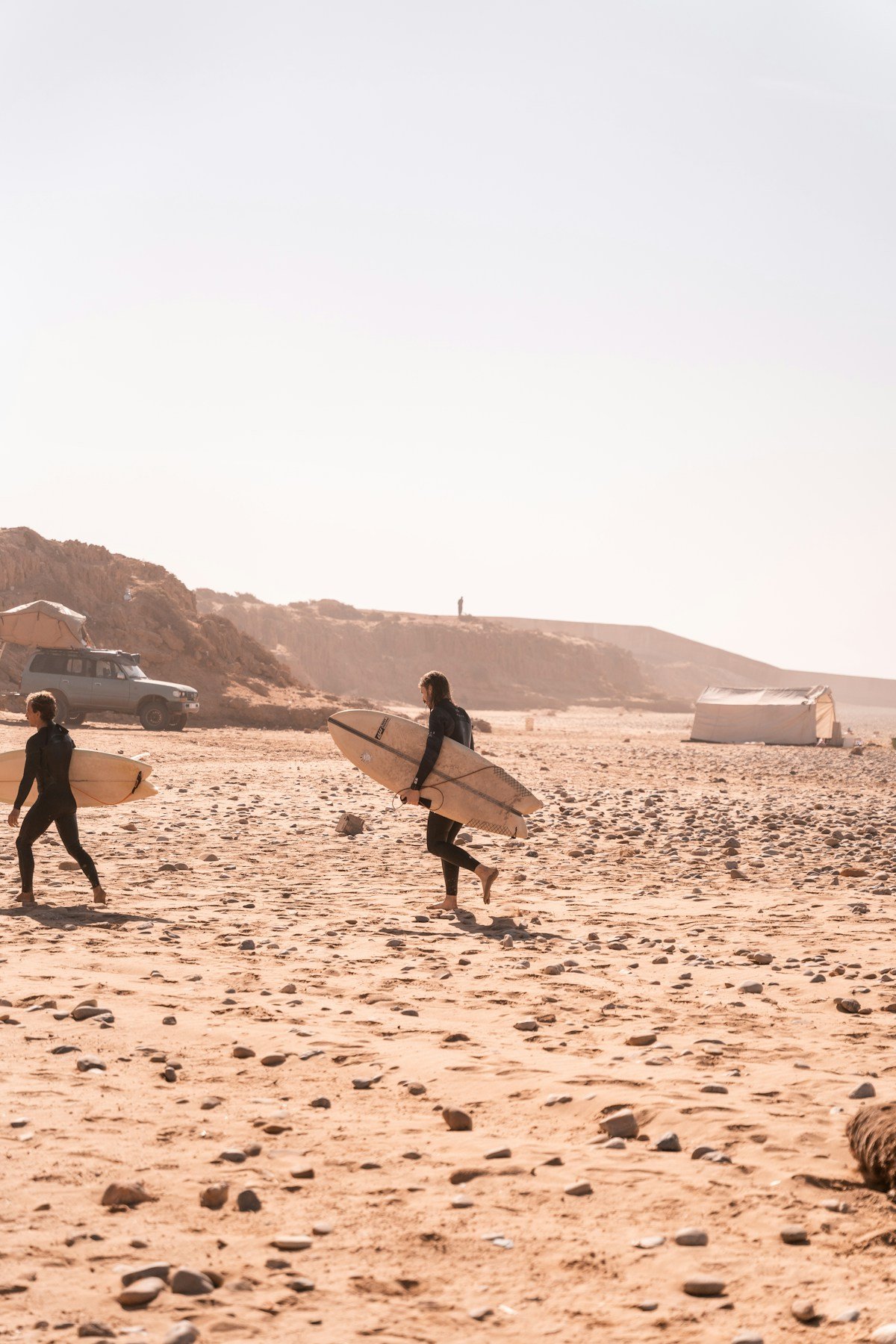
Taghazout is one of the most popular beginner surf destinations in the world - and for good reason. The Atlantic swells arrive consistently from the northwest, the water temperature stays between 18°C and 24°C year-round, and the beginner breaks at Panoramas and Banana Point offer exactly the kind of readable, forgiving waves that make learning to surf possible rather than miserable. This guide covers everything from which beach to start on to how long it takes to surf independently.
Best Beginner Beaches Near Taghazout
Not every break near Taghazout suits beginners. The headline breaks - Anchor Point, Killers, Mysteries - are powerful, fast-breaking point breaks that require experience to surf safely. For beginners, the following spots are where lessons take place.
Panoramas
The main beginner spot and where most surf schools start you. Panoramas is a right-hand break off a small rocky shelf, but the wave softens quickly into forgiving white water on smaller days. The sandy beach gives you a safe environment to practise and fail without significant consequence. Sessions here typically start in the white water (broken waves) before progressing to catching unbroken waves further out. Moderate crowds in peak season, but the break is wide enough that beginners aren’t in the way of more advanced surfers.
Banana Point
Located south of Panoramas toward Tamraght, Banana Point is a beach break with a softer, less structured wave than Panoramas - which actually suits absolute beginners well. There’s more room to spread out, the waves break more gradually, and the combination of sandy bottom and mellow energy keeps the consequences of wipeouts low. Many surf schools use Banana Point as a first session location for younger learners and families.
Tamraght Beach
The beach break directly in front of Tamraght village. A good intermediate option once you’re comfortable in the white water - the waves have a bit more punch than Banana Point but are still manageable at beginner level. A useful step between the mellow spots and the point breaks.
What a Surf Lesson Involves
A standard 2-hour beginner lesson in Taghazout follows a predictable structure, regardless of which school you book:
Land session (20–30 minutes): The instructor covers the basics on the sand. You learn the pop-up technique - the movement that gets you from lying on the board to standing - and practise it repeatedly on the beach until the muscle memory is starting to build. You also learn about reading waves, basic ocean safety, and how to fall without injury.
White water session (60–70 minutes): Into the water, working in the broken waves (white water). The instructor guides you into waves, you pop up, and you ride as far as the wave takes you. Most beginners stand up during this phase, even on the first session - the key is board size (the bigger the foam board, the easier it is to stand) and wave selection by the instructor.
Unbroken wave progression: Depending on your progress, the instructor may take you further out to catch smaller unbroken waves toward the end of the session. This is where the real learning accelerates - reading the wave before it breaks, paddling to position, timing the pop-up.
Surf School Costs
Prices are approximate as of 2026 and may vary by season and operator. Always confirm current rates directly with the school.
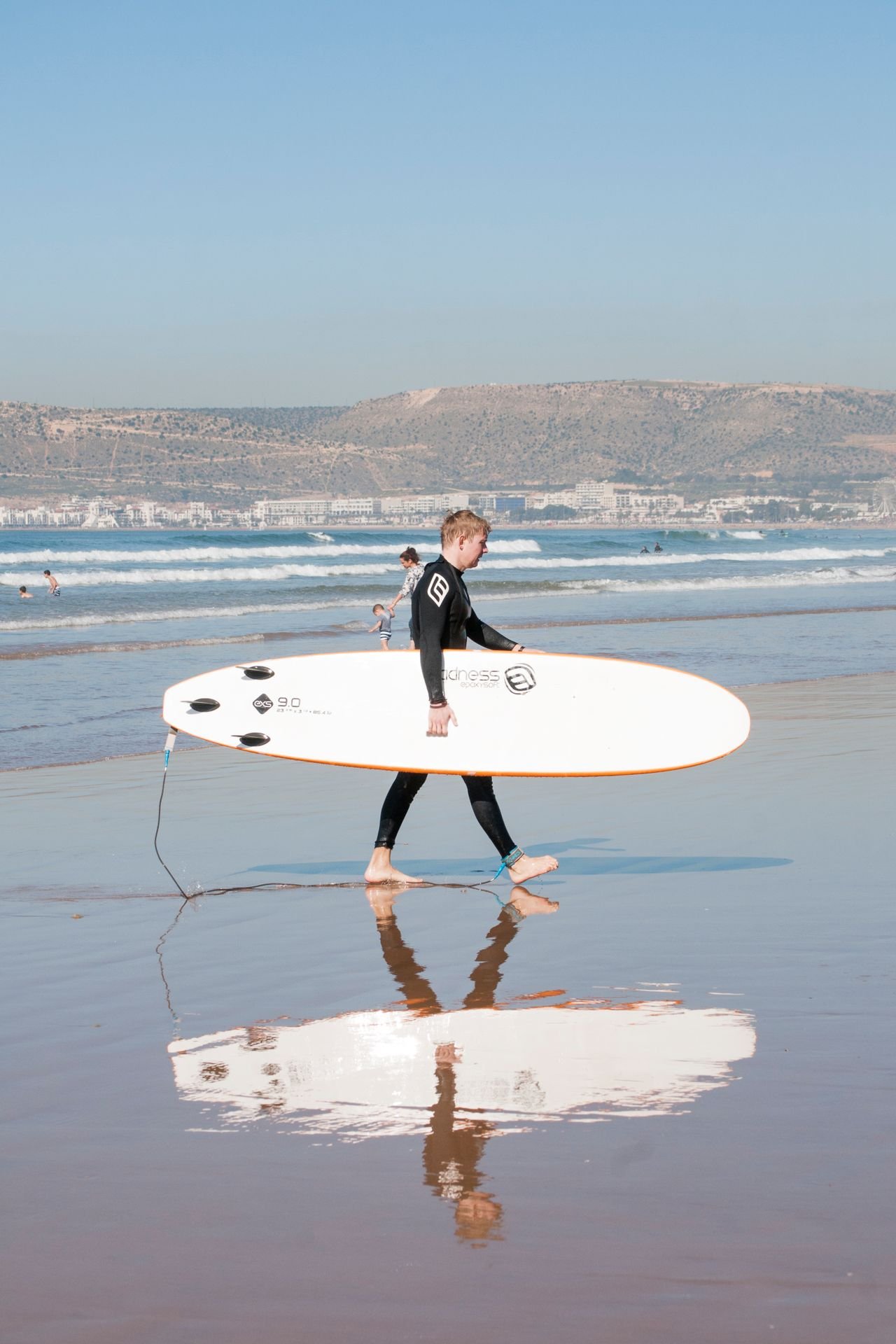 Agadir bay has gentle beach breaks, with the city skyline in the background.
| Format | Approximate Cost |
|---|---|
| Single 2-hour group lesson | 350–500 MAD |
| Single 2-hour private lesson | 600–900 MAD |
| 5-session group package | 1,500–2,200 MAD |
| 10-session group package | 2,500–4,000 MAD |
| Week surf camp (includes accommodation) | €380–700 depending on tier |
Group lessons run at ratios of 1:4 to 1:8 depending on the school and season. Private lessons are worth the extra cost if you have a specific technical problem to solve or if you want faster progression. For first-timers on a budget, group lessons at a reputable school produce results.
Best Time of Year for Beginners
October–April: The peak surf season on Morocco’s Atlantic coast. Swells are consistent and often larger - the main beginner breaks at Panoramas and Banana Point are manageable, but conditions vary more day-to-day. Water requires a 3/2mm wetsuit. Camps are busy; book ahead.
May–September: Lower swell periods, particularly June–August. Conditions are calmer and more predictable, which suits absolute beginners well - fewer big sets, cleaner water. Air and water temperatures are higher (wetsuit optional in summer). More flexibility in booking.
If your primary goal is learning to surf rather than chasing specific waves, the shoulder seasons (May and September/October) hit the best balance - manageable conditions, lighter crowds, and good weather.
What to Bring to a Surf Lesson
Your surf school will provide a foam board (typically 8–9 ft for beginners) and a wetsuit. You need:
- Swimwear under the wetsuit
- Rash guard or lycra top (optional but reduces wetsuit rash on longer sessions)
- Sun protection - the Moroccan Atlantic sun reflects off the water and is more intense than it feels. Apply SPF50+ before going in the water, including on the back of your neck and legs
- Water bottle - bring water to the beach; sessions are physically demanding
- Flip-flops or sandals for walking to and from the water on rocky sections
Leave valuables at your accommodation. Most surf schools have a spot to leave bags on the beach but cannot guarantee security.
How to Choose a Surf School
The key factors: instructor-to-student ratio (1:4 is good, 1:8 means minimal individual attention), foam boards for beginners, ISA-certified instructors, and break selection based on the day’s conditions rather than habit.
For a full named comparison of schools - Surf Berbere, Surf Maroc, Moroccan Surf Adventures, Ocean Vagabonds and others - with prices and a guide to what separates them, see the dedicated Taghazout surf schools guide. You can also book a surf lesson in Taghazout directly on GetYourGuide, which includes board and wetsuit hire.
Progression Timeline: What to Expect
Session 1: Most beginners stand up in white water. You’ll wipe out a lot. That’s correct.
Sessions 2–5: White water becomes more consistent. You start reading when to pop up and developing muscle memory. Catching unbroken waves becomes possible on smaller days.
Sessions 6–10: Riding unbroken waves becomes reliable. You can paddle yourself into position and select waves without the instructor guiding each one. You’re surfing - not perfectly, but independently.
After 2 weeks of daily surfing: You can surf green waves unassisted, work on turning, and read the break. This is where Taghazout’s point breaks start to become accessible (Hash Point on smaller days).
Progress varies considerably based on fitness, body awareness, age, and the quality of coaching. Most people are pleasantly surprised at how quickly they stand up for the first time.
Safety
The beginner breaks at Taghazout are genuinely safe in appropriate conditions. A few notes:
- Always listen to your instructor about when to enter and exit the water. Conditions change.
- Rip currents are relatively rare at the main beginner spots but exist at every ocean beach. Learn to identify them (water moving away from shore) and know that swimming parallel to shore, not against the rip, is the correct response.
- Surfboard leash - your board is attached to your ankle. When you wipe out, let go and let the leash do the work. Don’t try to hold the board.
- Other surfers. The lineup has etiquette. As a beginner in white water, the main rule is: don’t drop in on someone already riding a wave. Your instructor will coach this.
- Sunscreen. Repeated UV exposure reflected off water causes burns faster than most people expect, especially in spring and summer.
- Travel insurance. Surfing is a physical activity with real wipeout risk. Make sure your policy covers water sports - VisitorsCoverage travel insurance explicitly covers surf activities and is popular with visitors to Taghazout.
Top Surf Lessons in Taghazout - Book on GetYourGuide
GetYourGuide lists multiple surf operators around Taghazout with instant confirmation and free cancellation up to 24 hours ahead. All lessons include board and wetsuit hire.
| Tour | Duration | What’s Included | Price |
|---|---|---|---|
| Surf Lesson and Practice | 2 hours | Board, wetsuit, instructor, free practice session after lesson | From approx. $38/person |
| Surf Lessons with Local Instructor | 2–3 hours | Board, wetsuit, ISA-qualified local coach | From approx. $43/person |
| Surf Lesson with Lunch and Transfer from Agadir | 3 hours | Board, wetsuit, certified coach, Moroccan lunch, hotel pickup from Agadir | From approx. $49/person |
| 5-Day Surf Camp with Lessons and Excursions | 5 days | Daily lessons at Anchor Point, Panoramas and Devils Rock, accommodation, excursions | From approx. $586/person |
Prices as of 2026 - check GYG for live availability. Private lessons run around twice the group rate but deliver measurably faster progression. Browse all Taghazout surf lessons on GetYourGuide →
For same-day or next-day bookings, our last-minute tours page lists surf lessons and activity slots with confirmed availability.
See also: surf camps in Taghazout · surfboard rental · best time to visit · Taghazout surf forecast guide · Panoramas surf spot guide · surfskate rental in Taghazout · one-week Morocco surf trip itinerary