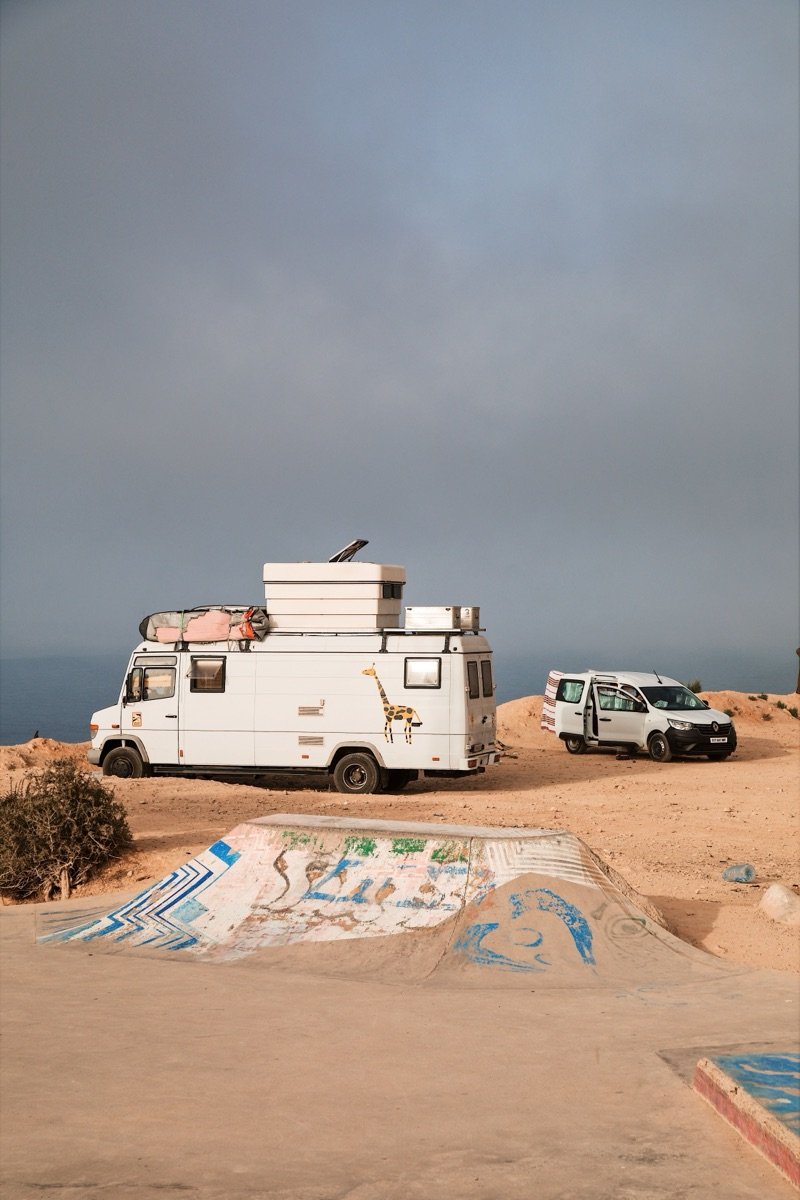
The Atlantic coast of Morocco from Agadir to Marrakech is one of the genuinely good driving routes - coast road through argan forest, fishing villages with blue boats and white walls, a UNESCO medina, and finally the chaos and colour of the interior city. This road trip uses Taghazout as its surf base and Marrakech as its finish line, taking in the bay at Imsouane, Essaouira’s port, and the mountain road inland as it goes.
Allow 10 days minimum. The route covers approximately 600 km total, but this isn’t about distance - it’s about the stops.
Before You Go
Hire car: Non-negotiable for this trip. Book a hire car at Agadir airport well in advance - peak season (November–February) sees limited desk availability and inflated walk-up rates. Most international companies operate at AGA; pick up on arrival day.
International driving licence: Not required for most EU and UK licence holders in Morocco, but carry it regardless. Some local rental companies ask.
Road conditions: The N1 coast road and N8/P2010 inland routes are paved and maintained. Driving standard is lower than European norms - expect pedestrians on main roads, slow-moving lorries, and donkey carts on rural stretches. Drive defensively, especially at dusk.
Fuel: Fill up in Agadir before leaving - petrol stations become less predictable north of Tamraght. Major towns on the route (Agadir, Essaouira, Marrakech) all have reliable stations.
Flights: Most EU cities connect directly to Agadir (AGA). Search flights to Agadir. For return, Marrakech Menara Airport (RAK) connects to even more EU cities than AGA - consider a one-way rental (Agadir in, Marrakech out) if the price is right. One-way fees vary by company.
Travel insurance: Get covered before departure.
Day 1: Fly into Agadir, Pick Up Car, Drive to Taghazout
Land at AGA. Collect hire car from the rental desk - allow 30–45 minutes for paperwork and vehicle inspection. Photograph any existing scratches before leaving the lot.
Drive north 20 km to Taghazout. The road runs through Inezgane and Agadir’s northern suburbs before the coast opens up. Taghazout is signposted.
Check in. Search accommodation in Taghazout - book ahead, especially in peak season. For a surf-focused road trip, a guesthouse in the village works better than a surf camp (you want morning flexibility to move when the swell arrives, not a fixed van schedule).
Evening: walk the village, eat, watch Hash Point in the last light.
Days 2–4: Taghazout Surf Base (3 nights)
Three full days is enough to get properly in the water, explore the area, and recharge before moving.
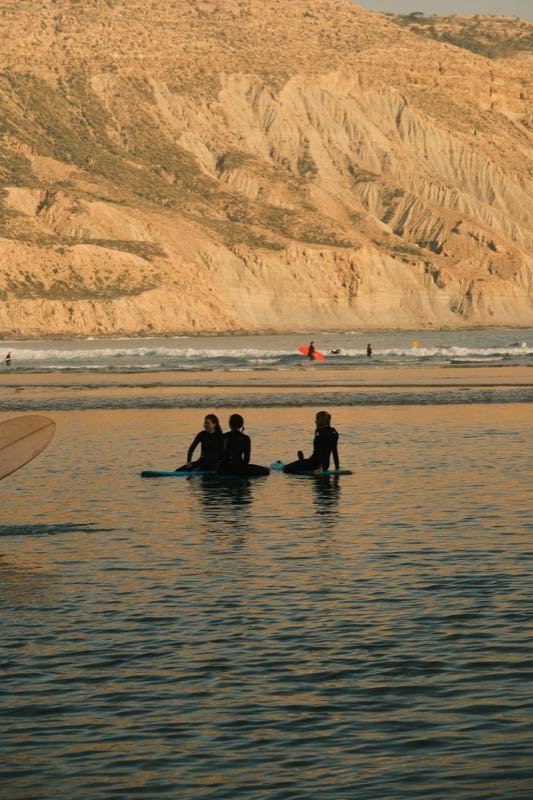 Early morning line-up on the Taghazout coast, where the three-night base is set.
Surf
Day 2: If you’re beginner–intermediate, book a surf lesson for the morning - Panoramas or Banana Point, the standard teaching breaks. Approximately 250–450 MAD per person.
Day 3: Free surf. Hash Point if conditions allow (best on 1.5–2.5m NW swell, incoming tide). The wave runs from the point rock into the bay - 150–200m on a good day. If you’re not at that level, Panoramas is the default.
Day 4: Dawn session at whichever break fired best in the days before. Pack and load the car before 11 AM.
Explore
- Agadir day trip (Day 2 or 3 afternoon): 20 km south, 20 minutes. Souk El Had for shopping, Kasbah ruins for views, marina for lunch. Grand taxi 15–25 MAD shared.
- Paradise Valley: 45 minutes inland. The palm gorge and rock pools are one of the best non-beach experiences in the region. Book a guided half-day trip or drive yourself (the road is paved to the car park).
- Tamraght (Aourir): 3 km north of Taghazout. The larger market town has more local food options and a beach break different in character to Panoramas.
Day 5: Taghazout to Imsouane (70 km north, ~1 hour)
Morning session at Hash Point or Anchor Point if conditions are right - early, before the wind picks up. Pack, check out, drive north.
The N1 runs north through Aourir and Tamraght before reaching Imsouane. The road passes above the coast on cliff sections with views worth stopping for.
Imsouane: a small fishing village with two surf breaks. Check in. Search accommodation in Imsouane - options are basic guesthouses and surf hostels, approximately 150–400 MAD per night. Book ahead in peak season; the village is small.
Afternoon: walk the village, hire a board, surf the bay if conditions allow. The bay is a long, slow right that suits late afternoon low-tide sessions.
Day 6: Imsouane Bay
This is the reason to overnight in Imsouane rather than day-trip from Taghazout: the bay at dawn is close to empty, conditions are at their cleanest, and the ride quality is different from anything in Taghazout.
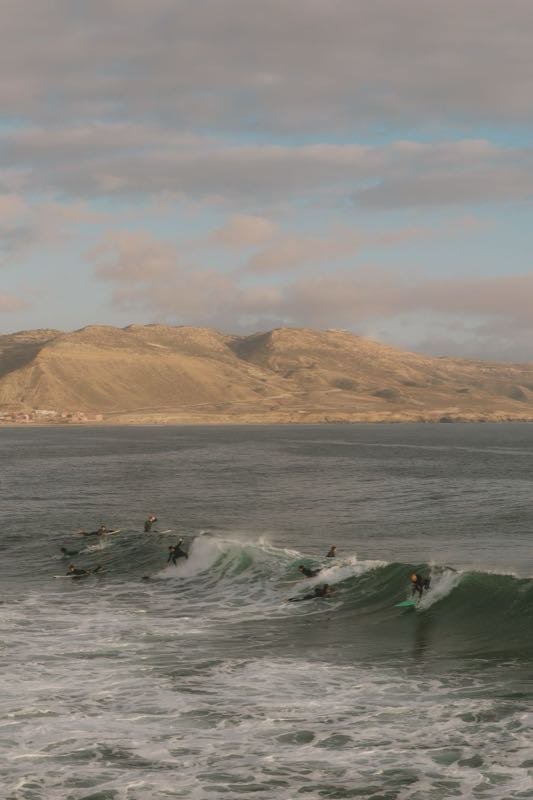 The long, slow wave at Imsouane suits both improvers and longboarders.
The Bay: One of Morocco’s longest waves. A slow right-hander that unloads on a wide sandy point - on a solid 1.5–2m day, it runs 200–400m. Perfect for working on trim and turns, especially if you’ve been confined to shorter Taghazout breaks. The Cathedral (the adjacent faster reef break) is for experienced surfers.
Hire boards locally: approximately 80–150 MAD per day.
Afternoon: explore the village, eat fresh fish at the harbour. Pack for tomorrow’s drive.
Day 7: Imsouane to Essaouira (100 km north, ~1.5 hours)
Morning session on the bay, then drive north. The P2201 coast road passes Sidi Kaouki - a kite and windsurf beach worth a stop if the trade wind is howling. From the viewpoint above Sidi Kaouki, you can often see dozens of kites airborne simultaneously.
Arrive Essaouira midday. Park outside the medina walls (the old city is mostly pedestrianised). Search hotels and riads in Essaouira - riad options inside the medina from approximately €40–120 per night; marina hotels from €60–150.
Afternoon: first walk through the medina. The Skala de la Ville (sea rampart) runs along the top of the fortifications facing the Atlantic - the view of the open ocean and the fishing fleet is worth the climb. The port-side grill stalls serve lunch from approximately 80–120 MAD.
Day 8: Full Day Essaouira
Morning: The medina before 10 AM, before the day-trip coaches from Marrakech arrive (Essaouira is a standard day trip from Marrakech, so midday gets busy). The blue-painted fishing boats moored in the inner harbour, the rampart cannons pointing west, the woodworking souks inside the walls - all more atmospheric without crowds.
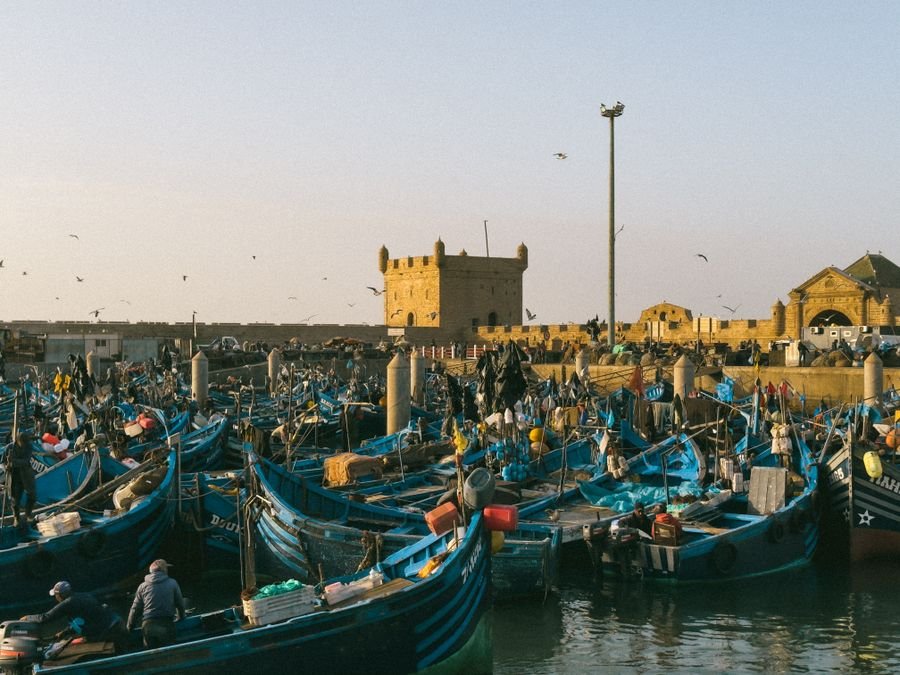 Essaouira port at dusk, with the sea bastion above the fishing fleet.
Afternoon: The main beach. Essaouira’s beach is wide, flat, and almost always windy - excellent for kitesurfing and windsurfing, less ideal for ocean swimming due to the current. Surfing is possible but conditions are typically choppy. The beach town 2 km south (Diabat) is quieter.
If you’d prefer guided coverage of Essaouira’s highlights, the Essaouira guided day trip from Agadir or Taghazout provides a local guide through the medina, port, and key sites - useful context even if you’ve already arrived independently.
Evening: Dinner in the medina. The fish restaurants around Place Moulay Hassan serve excellent set menus (approximately 150–250 MAD per person). The square itself is good for mint tea and people-watching.
Day 9: Essaouira to Marrakech (190 km east, ~2.5 hours)
The drive inland is a different Morocco. The coast road gives way to the P2210 through argan forest, the road climbs through Chichaoua, and then the High Atlas comes into view ahead of Marrakech. The landscape shifts from Atlantic scrub to red earth to the rose-red walls of the city.
Arrive Marrakech by early afternoon. Park at one of the gated car parks outside the medina walls - driving inside the medina is impractical and unnecessary.
Check in. Search hotels in Marrakech - the medina has riads at all price points (budget options from €25–50, mid-range from €60–150, luxury from €200+); Guéliz (the new town) has modern hotels if you prefer. Book ahead - Marrakech has very high occupancy year-round.
Afternoon: walk to Jemaa el-Fna, the central square. The circus starts properly at sunset - snake charmers, musicians, food stalls with clouds of smoke from the charcoal grills, acrobats. The energy at dusk is one of Morocco’s defining experiences.
Day 10: Marrakech
Morning: The souks inside the medina before 11 AM. Carpet souks, spice markets, the metalworkers’ quarter, the tanneries (best viewed from the riad balconies above). Haggling is expected; starting prices in tourist areas are typically 3–5x the settled price.
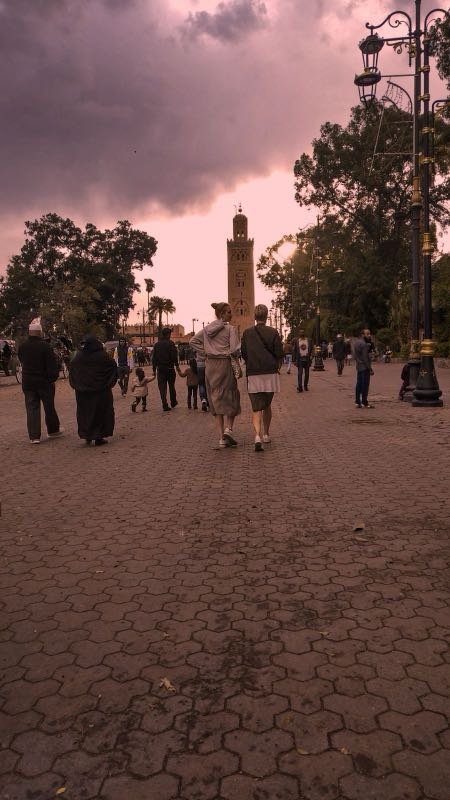 The Koutoubia minaret is a handy landmark when you are finding your way around Marrakech.
The Medina highlights: Bahia Palace (approximately 70 MAD entry), Saadian Tombs (70 MAD), and the Mellah (old Jewish quarter) are all walkable from Jemaa el-Fna.
Afternoon: Majorelle Garden (80 MAD entry, book online to avoid queues), and the adjacent Yves Saint Laurent museum (150 MAD) if contemporary design interests you.
For organised activities from your Marrakech base: a guided Marrakech shared day trip covers the major sites with commentary; for something more structured, the full-day Marrakech guided trip with lunch includes the major medina highlights and a traditional lunch stop.
Evening: Final dinner in Marrakech. The rooftop restaurants above the medina offer views over the city at night - Jemaa el-Fna lit up below is worth the slightly inflated prices. Budget 200–400 MAD per person for a sit-down dinner with drinks.
Return: Fly from Marrakech or Drive back to Agadir
Option A - Fly from Marrakech (RAK): Return the hire car to the Marrakech airport rental desk (check your rental agreement for one-way fees). Marrakech Menara Airport connects to most EU cities, often with more frequency than Agadir. Search return flights from Marrakech.
Option B - Drive back to Agadir: The direct route south from Marrakech to Agadir via the Tizi n’Test mountain pass (N10) is approximately 240 km - 3.5–4 hours and one of Morocco’s great driving roads, with High Atlas views that earn the detour. The N1 coastal route south (via Essaouira) is longer but flatter. Return the hire car at AGA.
Road Trip Budget Summary
All figures approximate as of 2026. Excludes flights.
| Segment | Budget (MAD) | Mid-Range (MAD) |
|---|---|---|
| Taghazout (4 nights) | 1,800–2,800 | 3,500–5,500 |
| Imsouane (2 nights) | 700–1,200 | 1,200–2,000 |
| Essaouira (2 nights) | 1,200–2,000 | 2,500–4,000 |
| Marrakech (2 nights) | 1,200–2,000 | 3,000–5,500 |
| Car hire (10 days) | 1,500–2,500 | 2,500–4,000 |
| Fuel (600 km) | ~400–600 | ~400–600 |
| Activities + tours | 1,000–2,000 | 2,000–4,000 |
| 10-day total | ~7,800–13,100 MAD | ~15,100–25,600 MAD |
| Approximate EUR | €710–1,190 | €1,375–2,330 |
Budget: guesthouses and budget riads, local restaurants, shared taxis where applicable. Mid-range: boutique riads and hotels, sit-down meals throughout, guided tours. Surf camp at Taghazout replaces the accommodation and lesson costs for Days 2–4 with a single package fee.
Book This Road Trip
- Flights → search Aviasales · flights to Agadir guide
- Hire car → GetRentacar, Agadir Airport · car rental in Agadir guide
- Airport transfer (if needed) → Kiwitaxi · airport transfer guide
- Taghazout hotels → Booking.com
- Imsouane hotels → Booking.com
- Essaouira hotels → Booking.com
- Marrakech hotels → Booking.com
- Surf lessons Taghazout → GetYourGuide
- Paradise Valley guided trip → half-day from Taghazout
- Essaouira guided day trip → from Agadir or Taghazout
- Marrakech shared day trip → guided from Taghazout/Agadir
- Marrakech with lunch → full-day guided tour
- Travel insurance → VisitorsCoverage for Morocco · travel insurance guide
See also: one-week Morocco surf itinerary · two weeks Taghazout and beyond · Taghazout long weekend · car rental in Agadir guide · Essaouira day trip from Taghazout · surf camps vs independent guide