
Taghazout has become a quiet fixture on the European digital nomad circuit for a specific kind of worker: someone who wants morning surf, Atlantic light for the afternoon, and a working environment that isn’t a grey city coworking floor. The infrastructure to support this has caught up with the reputation. Here is a practical guide to everything you need to set up and work effectively in Taghazout.
Why Nomads Choose Taghazout
The pitch is simple. Consistent surf, low living costs, fast internet at dedicated spaces, and a short flight from the UK and mainland Europe. Agadir Al Massira Airport (AGA) is 40 minutes from Taghazout by taxi, and direct routes connect from London, Manchester, Paris, and Bordeaux year-round.
Morocco is in the GMT+1 time zone (Western European Time, no daylight saving). This gives solid overlap with European clients: a 9-to-5 in Taghazout is a 9-to-5 in the UK, and an 8am call works fine with central European colleagues. US East Coast overlap is limited but manageable for evening calls.
The nomad community here is smaller than Lisbon or Bali. There is no Nomad List-famous weekly meetup and no megaspace. What there is: a growing cluster of surf camps and coworking spaces that have built out proper remote work infrastructure, and a steady stream of nomads who return each winter because it works for them.
Coworking Spaces: What to Expect and What to Pay
Three dedicated coworking spaces operate in the Taghazout-Tamraght corridor:
SunDesk (Taghazout): The most established dedicated space. Ocean views, 200+ Mbps fibre, ergonomic seating, and a community of location-independent workers. Day passes are available. The atmosphere is more structured than a cafe and better suited to focused work days. sun-desk.com
CoworkSurf (Taghazout): Full-floor coworking with ocean views, capacity up to 30 people, and 200 Mbps fibre. Designed specifically for the surf-and-work crowd, with surfboard storage and connections to local surf schools. coworksurf.com
Kasbari (Tamraght): The garden option. Set in a leafy outdoor space in Tamraght, 50 MAD for a half day and 80 MAD for a full day. Weekly and monthly passes available at reduced rates. 200 Mbps wifi, office chairs, meeting room, kitchen, and lockers. kasbari.com
For cafe-based working, see the full co-working cafes guide for Taghazout and Tamraght, which covers Teapot Cafe, Cafe Medina, Adam’s Cafe, and Hey Yallah in detail.
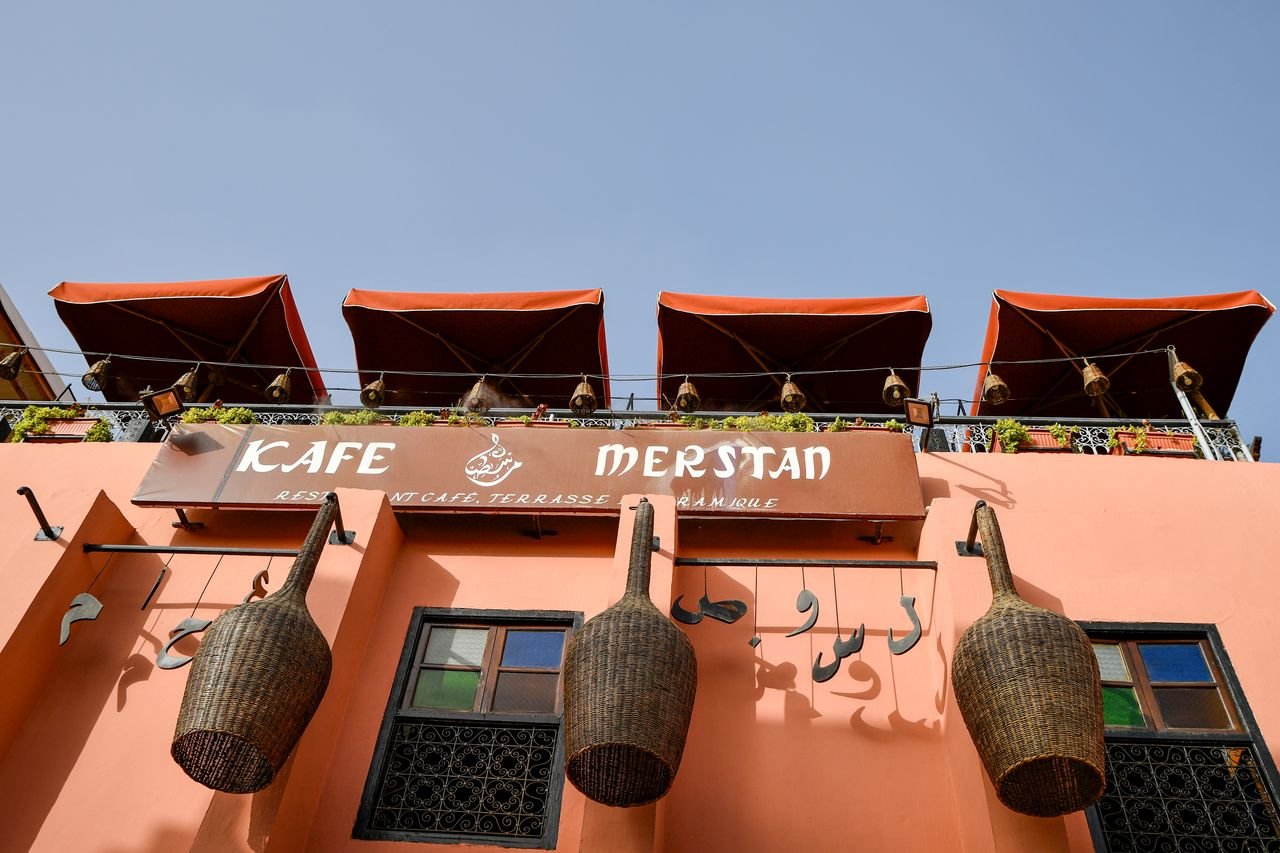 The ochre facade of a medina rooftop café.
Internet and Connectivity
Speed at dedicated coworking spaces is 200 Mbps and reliable for video calls, file uploads, and cloud work. Cafe wifi typically runs 10 to 30 Mbps, adequate for general work and individual video calls, but can drop during peak afternoon hours.
For mobile data, Maroc Telecom is the best network in the area. A 30GB bundle costs 150 MAD (approximately EUR 14) per month and provides 4G coverage throughout Taghazout, Tamraght, and Aourir. Coverage is reliable in the village and on the coast; it drops slightly on inland hikes.
If your phone supports eSIM, Airalo Morocco plans start from around $8 USD for 5GB and can be activated before you land. This is useful for the first day before you find a phone shop, though local SIM gives better value for longer stays. Full details at the SIM cards and internet guide.
Best Neighbourhoods for Remote Work
Taghazout village: The centre of the nomad scene. Most coworking options, cafes, and surf infrastructure are here or within walking distance. The main street cafes are busy and social. Better for people who want community around them while they work.
Tamraght: Two kilometres south of Taghazout, quieter and slightly cheaper. Kasbari coworking is here. More suitable for focused work without the tourist flow. Local restaurants and cafes cater to a regular crowd rather than passing visitors.
Aourir: Three kilometres south, a market town rather than a surf village. Very few nomad-specific facilities, but significantly cheaper accommodation for people who want to base themselves outside the surf scene.
For a full comparison of the two main bases, see Taghazout vs Tamraght.
Cost of Living Breakdown
All figures are in MAD (Moroccan Dirham). At the time of writing, 1 EUR is approximately 11 MAD and 1 GBP is approximately 13 MAD.
Accommodation
| Type | Per Night (MAD) | Per Month (MAD) |
|---|---|---|
| Hostel dorm | 100 to 180 | From 2,500 (shared) |
| Private room, guesthouse | 200 to 300 | 3,500 to 6,000 |
| Self-catering apartment | 1,500 to 3,000 per week | 5,000 to 10,000 |
| Surf camp (includes meals) | 600 to 900 per night | Not typically monthly |
Monthly apartment rentals give the best value. Rates for self-catering apartments are negotiable with landlords directly, and a month-long stay almost always commands a lower per-night rate than the weekly figure implies.
For long-stay accommodation options including coliving, see the coliving and long-stay guide.
Food
| Item | Cost (MAD) |
|---|---|
| Breakfast at a local cafe (msemen, eggs, tea) | 25 to 45 |
| Tagine lunch | 50 to 80 |
| Grilled fish dinner | 80 to 120 |
| Coffee | 15 to 25 |
| Mint tea | 5 to 15 |
Self-catering from Aourir market cuts food costs substantially. A week of groceries for one person runs 200 to 400 MAD.
Coworking and Connectivity
| Item | Cost (MAD/month) |
|---|---|
| Kasbari full-day pass (daily) | 80/day |
| Maroc Telecom 30GB SIM data | 150 |
| Airalo eSIM 5GB (one-off) | approx. 85 MAD |
Monthly Total: Realistic Nomad Budget
Lean budget (shared accommodation, local food, cafe wifi): 4,000 to 5,500 MAD per month (approximately EUR 365 to 500)
Comfortable budget (private apartment, dedicated coworking, eating out regularly): 7,000 to 10,000 MAD per month (approximately EUR 640 to 910)
Both figures exclude surf lessons, activities, and flights. The Taghazout budget guide has a full breakdown by category.
Visa and Residency
Morocco does not have a dedicated digital nomad visa as of October 2026. The standard approach is the visa-free 90-day window that applies to UK, EU, US, Canadian, and Australian passport holders (among many others). No advance application is needed: you receive an entry stamp at the airport and are permitted to stay up to 90 days.
If you want to extend beyond 90 days, the established practice is a border run to Spanish territory: Ceuta or Melilla are accessible by ferry from northern Moroccan cities, though this requires a domestic flight or overnight bus from Agadir first. Some nomads take a week in the Canaries or mainland Spain before returning for a new 90-day window.
Tax residency is a separate matter. Morocco is not a tax treaty partner of most EU countries, so tax obligations in your home country are not affected by your time here in most circumstances. Consult a tax professional if you plan to stay six months or more across a calendar year.
Moroccan dirham cannot be exchanged outside Morocco. Wise and Revolut work well for receiving international payments and managing money while you are here. Set up your payment infrastructure before you arrive.
Full entry requirements at the Morocco visa and entry guide.
Best Months for Digital Nomads
October to February: Peak nomad season. Consistent surf swell, temperatures between 18 and 24 degrees Celsius, and a community of longer-term nomads establishing their winter base. The clearest Atlantic light for photography and video content. Coworking spaces are active and the cafe scene is at its most developed.
March and April: Still excellent. Swell continues, prices drop slightly after the main winter peak, and the weather is warm enough for outdoor working sessions on terraces and rooftops. This is arguably the best-value window.
May and June: Transitional. Surf becomes less consistent, temperatures rise toward 28 to 30 degrees, and the nomad population thins out. Quieter and cheaper, good for people who want to focus without the peak-season crowd.
July and August: Busy with Moroccan and European summer tourism. Prices spike, accommodation is harder to find at short notice, and the surf is often flat. Generally not recommended for nomads unless you have accommodation locked in advance.
September: Shoulder season, underrated. The first autumn swells arrive, prices are still off-peak, and the nomad community starts arriving for the new season. Good combination of surf and calm working conditions.
The best time to visit guide has a month-by-month breakdown including surf conditions.
Practical Checklist Before You Arrive
Connectivity: Pick up an Airalo eSIM for Morocco before departure so you have data from the moment you land. Get a local Maroc Telecom SIM in Taghazout or Agadir for longer stays.
Insurance: Standard travel insurance often excludes surf, which is a category of adventure sport. VisitorsCoverage travel insurance covers adventure sports and extended stays in Morocco.
Money: Withdraw MAD at ATMs in Agadir or Aourir on arrival. Most small restaurants and shops are cash only.
Accommodation: Book the first two or three nights in advance, then find a longer-term arrangement in person. Direct negotiation with landlords gives better monthly rates than booking platforms.
Power: Morocco uses European-style two-pin sockets (Type C and Type E). Bring a universal adaptor if you’re coming from the UK or US.
Banking: Wise or Revolut for international payments. Local banks accept foreign cards for ATM withdrawals but international transfers are slow.
Co-working cafes in Taghazout and Tamraght SIM cards and internet setup Coliving and long-stay accommodation Taghazout vs Tamraght: which base suits you? Morocco visa and entry requirements Best time to visit Taghazout