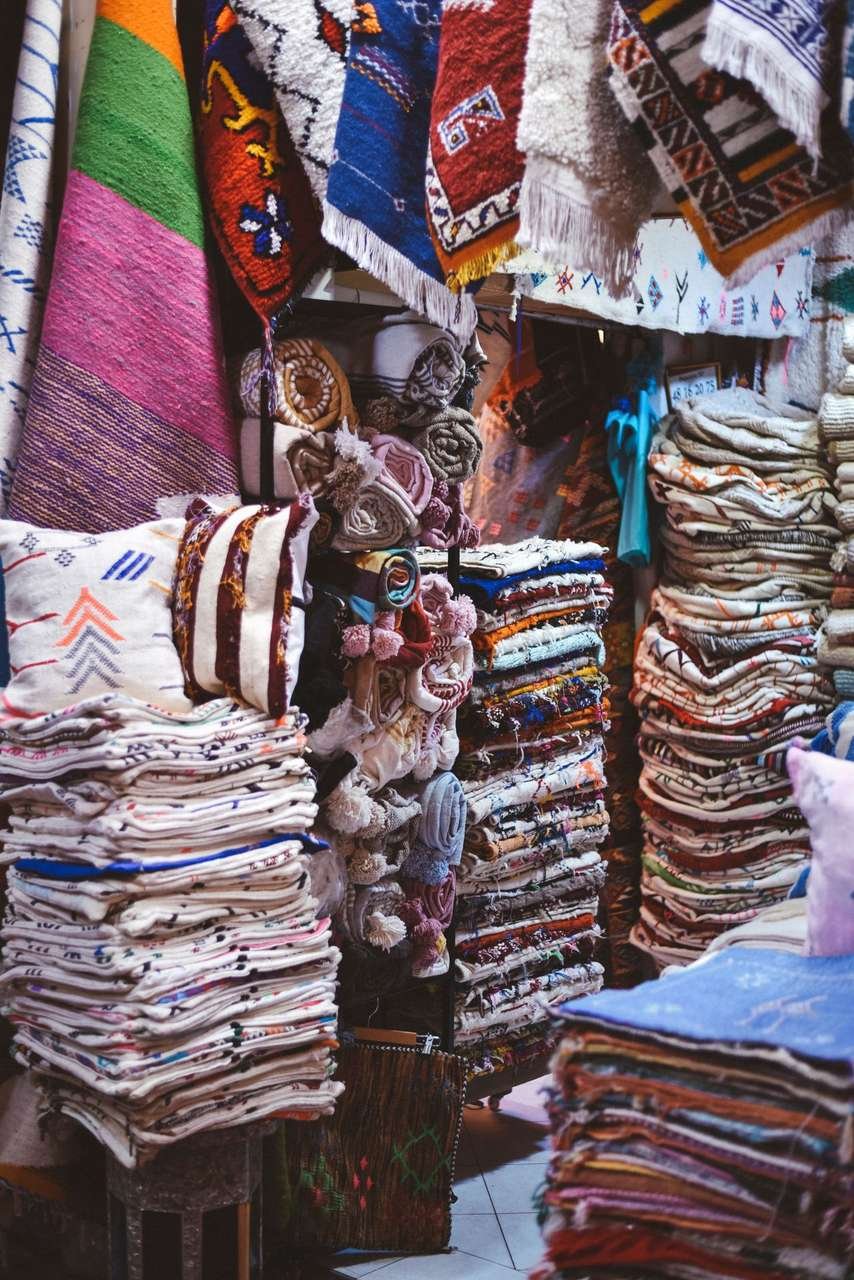
Taghazout is one of the most welcoming places in Morocco, but it is still a traditional Berber fishing village with its own social expectations. Surf camps and foreign visitors have softened some of the edges, but local customs around greetings, dress, religion, and hospitality are genuinely important here. Getting these right earns you real warmth from local people; getting them wrong rarely causes serious offence, but you will sense the difference.
This guide covers the practical side: what to wear where, how much to tip, how to bargain properly, what to avoid photographing, and how to behave when you are a guest in someone’s home.
Dress Codes
In the Village
Taghazout village itself is conservative by the standards of a beach destination. The main strip running through the village passes by the Mohammed V mosque, the weekly souk, and dozens of family homes. In this environment, covered shoulders and covered knees are the right call for both men and women. Loose linen trousers and a T-shirt work for men; a midi skirt or wide-leg trousers with a light top work for women.
Short shorts and crop tops in the village are not prohibited, but they attract attention that most visitors find uncomfortable, and they signal a lack of awareness that colours interactions with locals for the rest of the day. The adjustment is minimal and the goodwill it generates is tangible.
At the Beach and Surf Breaks
Beach dress is its own context. Bikinis and board shorts at Anchor Point, Hash Point, and Panoramas are completely normal. No local will take offence at standard swimwear on the beach or directly in front of surf camps. The transition point is when you leave the sand and walk through the village: cover up with a sarong or a T-shirt before stepping off the beach.
At Religious Sites
The Mohammed V mosque in Taghazout, like almost all active mosques in Morocco, is not open to non-Muslim visitors. If you are visiting the Hassan II Mosque in Casablanca on a broader Morocco trip, that is the significant exception: it admits non-Muslims on guided tours and requires covered shoulders, covered legs to the ankle, and removal of shoes.
At marabout shrines and zaouias you may encounter in the Souss region, the rule is the same: covered shoulders and legs, and always remove shoes if you are invited inside.
At Restaurants
Most restaurants in Taghazout and Tamraght have no formal dress requirement. At beachside cafes and surf camp dining areas, smart-casual is entirely fine. For dinner at higher-end restaurants in Agadir, such as Le Jardin d’Eau or those around Rue de la Plage, people tend to dress slightly smarter — clean clothes without beachwear. Nothing formal is needed.
Tipping Culture
Morocco has a clear tipping culture, and knowing the expected amounts prevents both under-tipping and being overcharged under the guise of a service fee.
Restaurants: A 10% tip is standard at sit-down restaurants where table service is provided. At street food stalls or hole-in-the-wall tagine spots in Taghazout, rounding up the bill is appreciated but not expected. If a service charge is already included on the receipt (rare outside Agadir hotels), no additional tip is required.
Surf instructors and guides: Surf instructors at Surf Maroc and similar camps receive a base wage but genuinely rely on tips as part of their income. For a half-day lesson, 50-100 MAD per instructor per person is appropriate. For a full week of guided surfing with daily feedback and session planning, 200-300 MAD at the end of the trip is reasonable and genuinely appreciated.
Taxis and transfers: Grand taxis and small transfers from Agadir-Al Massira Airport do not normally expect tips if the fare was agreed in advance. If a driver carries luggage upstairs or waits longer than expected, 10-20 MAD is fine.
Hammam attendants: At traditional hammams such as those in Tamraght and the hammam near Taghazout village centre, tip the attendant who scrubs you 20-30 MAD in addition to the service fee. At upmarket spa hammams in Agadir hotels, 50-100 MAD depending on the treatment length.
Hotel staff: In riad-style guesthouses such as Dar Amane in Taghazout, a tip of 20-30 MAD per bag to the porter and a small daily tip for the housekeeper (20-30 MAD) is the normal practice. In large international hotels in Agadir, the standard hotel tipping conventions apply.
When not to tip: You are not expected to tip in supermarkets, at petrol stations, or when buying from market stalls after you have already agreed a price. Offering a tip after a negotiated transaction can occasionally cause offence by implying you feel you over-paid.
Social Customs: Greetings and Conversation
Greetings
Moroccan greetings are multi-layered by Western standards. A proper greeting between two men typically involves a handshake followed by touching the right hand to the heart. Between men and women who are not familiar with each other, the default is no physical contact: a verbal greeting with eye contact is correct. Western women who extend a hand to shake will sometimes have it accepted, sometimes not — this varies entirely by the individual.
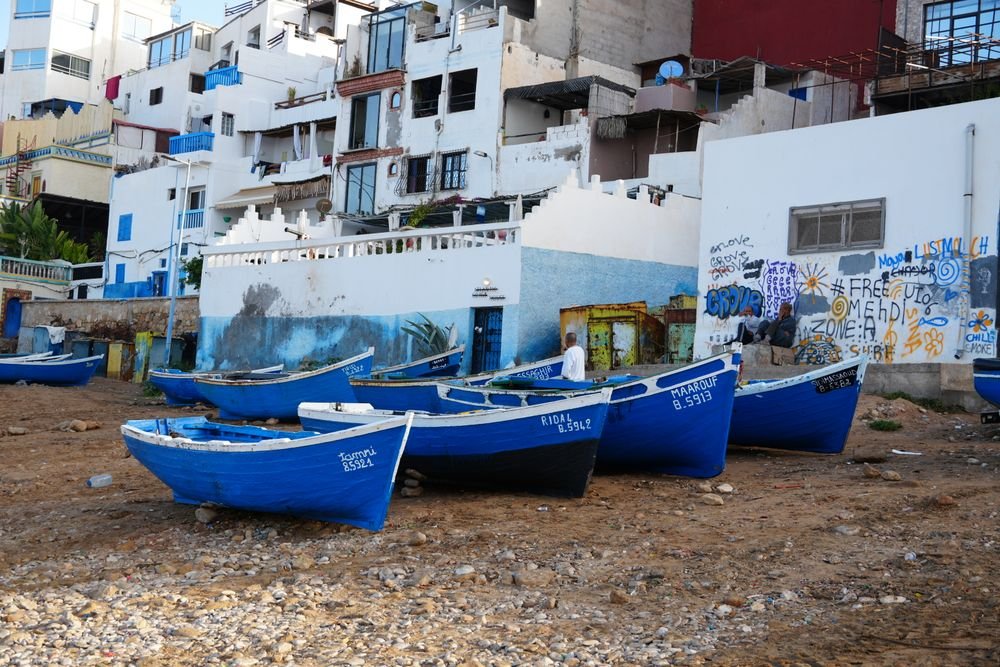 Blue boats on the pebbles beside whitewashed houses with street art.
Among people who know each other well, cheek kisses are normal (two or three, depending on the region). As a visitor who has just met someone, wait to see what they offer.
The phrase “As-salamu alaykum” (Peace be upon you) is the standard greeting across Morocco and carries weight beyond a simple hello. Responding “Wa alaykum as-salam” is polite and will earn you a smile almost every time. In the Souss region, Tachelhit Berber greetings (“Azul” for hello) are widely understood and even more appreciated.
Avoid Discussing the Western Sahara as a Controversy
In Morocco, the Western Sahara is considered sovereign Moroccan territory. Framing it as a disputed region or raising the Polisario Front as a legitimate counterpoint in casual conversation is viewed as offensive by most Moroccan nationals. If the topic arises, the practical advice is to listen rather than debate.
Ramadan
During Ramadan — which moves forward approximately 11 days each year in the Gregorian calendar — it is disrespectful to eat, drink, or smoke visibly in public between dawn and iftar (sunset). This applies in the village, in markets, and in the streets. Surf beaches and surf camp common areas are generally treated as separate contexts, but applying the same standard in public spaces is both polite and practical. Restaurants and cafes in Taghazout continue to serve food; they often do so in more enclosed spaces during daylight hours out of courtesy to fasting locals.
Bargaining
Bargaining is expected and entirely normal in Moroccan markets. At the Agadir souk in the Talborjt neighbourhood and at the weekly market in Taghazout, fixed prices are the exception rather than the rule for clothing, ceramics, leather goods, and textiles.
The general approach: the first price given is a starting point, typically 1.5 to 3 times what the seller will accept. A counter-offer of 40-50% of the asking price is not offensive — it opens the negotiation. Work towards a price you are both comfortable with, and once you reach agreement, the deal stands. Backing out after a price has been verbally agreed is considered bad form.
Bargaining does not apply to packaged goods in supermarkets, pre-priced items in fixed-price cooperatives (look for signs indicating “prix fixe”), or food at restaurants with printed menus. Attempting to bargain in these contexts will not succeed and may cause mild offence.
A useful rule: if you would not actually buy the item at the agreed price, do not start the negotiation.
Photography Rules
What Is Generally Fine
Landscapes, architecture, street scenes, and the Atlantic coastline around Taghazout photograph freely. The cliffs above Anchor Point, the Banana Village of Aourir, and Paradise Valley inland are all fair game with no sensitivity.
Always Ask First
Photographing individual people — especially women, elderly residents, and children — requires a verbal request. In most cases, people will say yes with a smile if you ask respectfully in French or Darija. Photographing someone without asking, and especially pointing a camera directly at a person in the village, is considered intrusive. Surf photography of other surfers in the water is generally fine and expected at busy breaks.
What to Avoid
Do not photograph the interior of mosques, government buildings, military installations, or police checkpoints. Photographing people in private moments — eating, praying, inside their homes — without explicit permission is both culturally disrespectful and, in some cases, legally problematic in Morocco.
At Souss Massa National Park south of Agadir, photography within the reserve is permitted. Flamingos on the Oued Souss estuary are one of the better wildlife subjects in the region.
Dining Etiquette
Traditional Moroccan meals involve a central communal dish, typically a tagine or couscous, placed in the centre of the table with everyone eating from it directly. At family-style restaurants and at homes, use your right hand or a piece of bread to eat from the part of the dish nearest you rather than reaching across to the other side.
Couscous is traditionally a Friday meal, served after Friday prayers. Ordering it at a dedicated couscous restaurant — or accepting it in someone’s home — on a Friday carries more significance than ordering it any other day of the week.
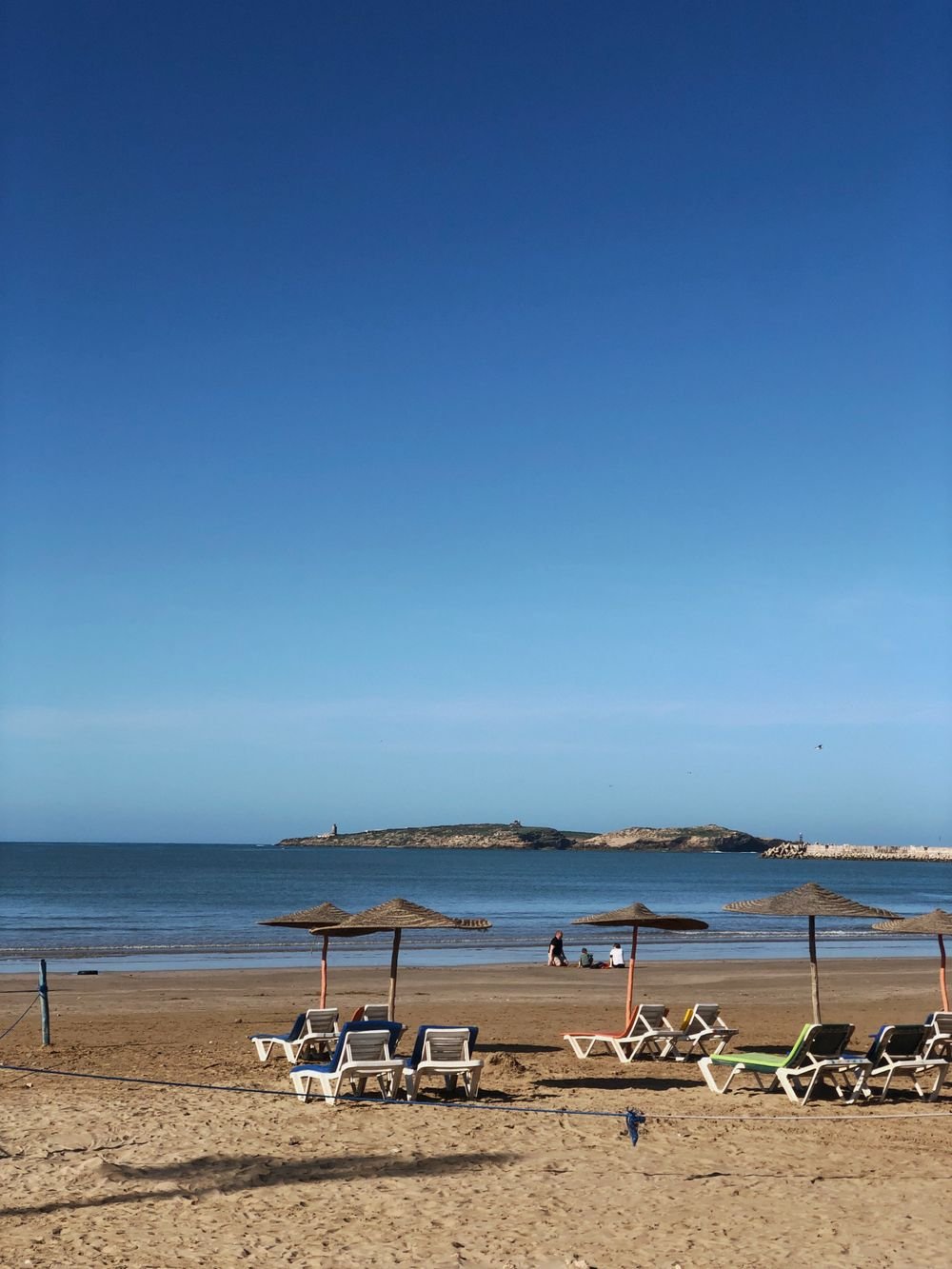 Sun loungers and straw parasols on a calm Moroccan beach.
Tea is an important ritual. Moroccan mint tea is served in three pours from a height, which aerates the tea and is itself a sign of hospitality and skill. It is considered rude to refuse tea when offered, particularly in a home or at a shopkeeper’s invitation during a market visit. You are not obligated to buy anything after accepting tea, but the invitation itself deserves a genuine yes.
At restaurants that serve alcohol — and several in Agadir do — wine and beer are listed without fanfare. In village eateries and traditional Moroccan restaurants in Taghazout, alcohol is not served. Do not ask for it.
Behaviour in Homes
Being invited into a Moroccan home is a significant gesture and treated accordingly. Remove your shoes at the door — even if not explicitly asked, you will see shoes lined up at the entrance. Wait to be directed to a seat rather than choosing your own. Accept any food or drink offered; refusing repeatedly suggests something is wrong with the hospitality.
If the household is observant, you may be directed to a separate area from members of the opposite sex during a mixed-group visit. Follow the host’s lead without comment.
Bringing a small gift — a box of sweets (pastillas), fruit, or quality dates — is appropriate for a dinner invitation but not obligatory for a short tea visit. Gifts are typically not opened immediately in front of the giver; this is normal and not a sign of disinterest.
Leave within a reasonable time after the meal. Extended visits are welcome when the host is clearly enjoying the company, but Moroccan hospitality does not make it easy to signal that it is time for guests to leave — reading the room matters here.
A Note on Interaction with Local Guides
In Taghazout and around Agadir, you will meet people who offer to help with directions, recommendations, or connections to specific shops or experiences. Some are genuinely helpful; others receive commissions from the establishments they steer you to. A polite but clear “La, shukran” (No, thank you) is understood and respected. You do not need to justify it further.
Agreed prices with guides or drivers should be settled before you start rather than after you arrive. Verbal agreements in Morocco carry social weight; follow through on them.
Taghazout rewards visitors who engage with its culture rather than just its surf. The village has absorbed decades of international guests without losing its identity largely because local people have maintained real standards around how that engagement happens. The customs here are not difficult — they are just worth knowing before you arrive.