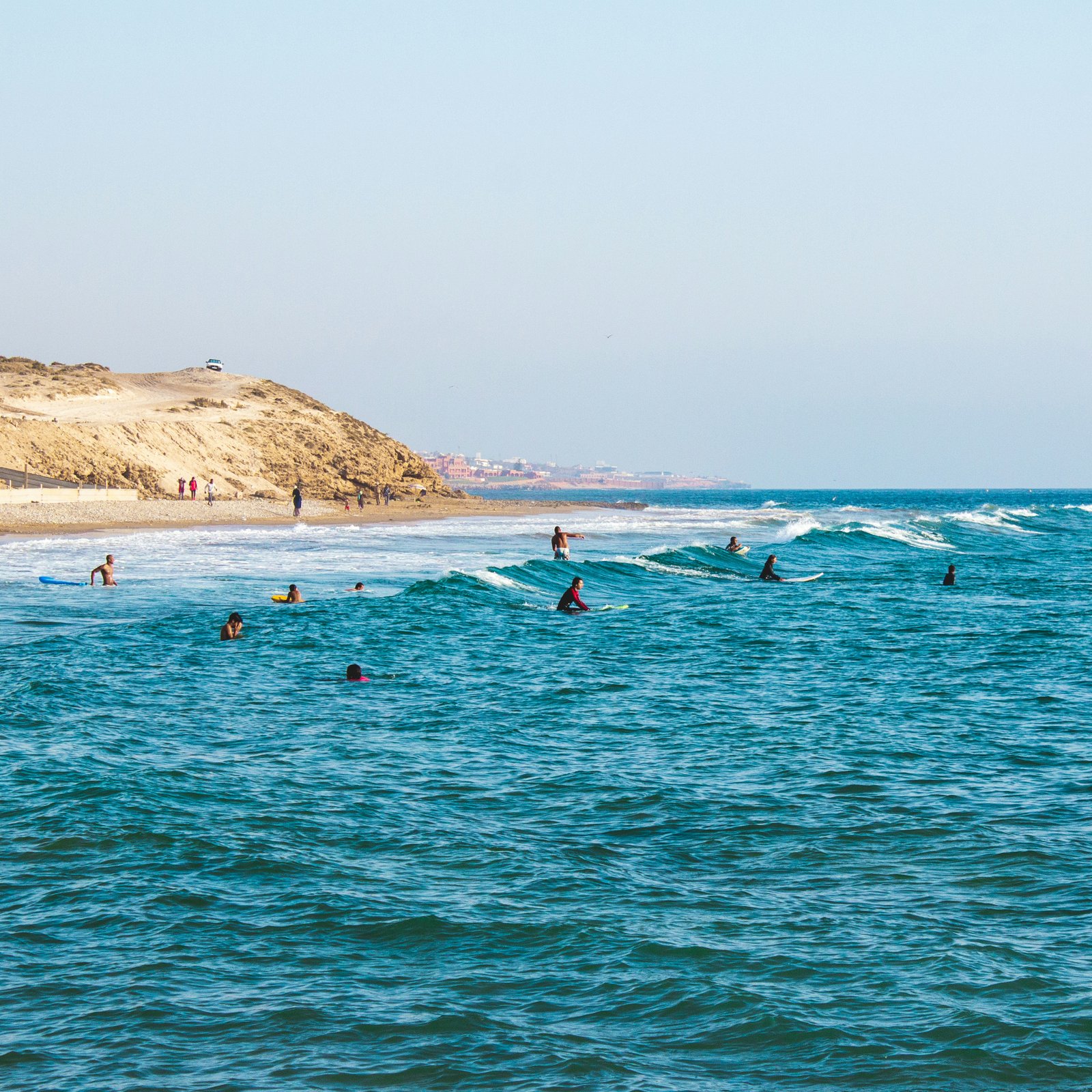
Morocco has one of the most varied surf coastlines in the world. A single Atlantic-facing shore runs from the Mediterranean straits all the way south through the Western Sahara, picking up North Atlantic swells from October through April and generating consistent summer options further south. Four destinations dominate the conversation for surf travellers: Taghazout, Imsouane, Dakhla, and Essaouira. Each has a different character, wave type, and audience. Here is how they compare.
Taghazout: The Hub
Taghazout is Morocco’s most developed surf destination and the one most international travellers arrive at first. Positioned on the Atlantic coast roughly 20 km north of Agadir, it has a concentration of breaks in a small area that suits every level - beginners on the sandy beaches at Banana Point, intermediates at Hash Point and Mysteries, and advanced surfers at Anchor Point and Killers.
The waves: Anchor Point is the headline break - a long right-hand point that can run for 300 metres or more on a good swell, with powerful, hollow sections that require solid surfing ability. Hash Point is a gentler right-hand reef immediately below the village, workable for intermediate surfers in moderate conditions. Banana Point to the south provides beach break for beginners and those learning. Killers, close to Anchor Point, is a heavy reef suited to experienced shortboarders who want something more serious.
Best season: October to April for consistent, quality surf. February to March is peak season - swells are regular and the water is cold (approximately 17–18°C), so a 3/2mm wetsuit is standard. Summer (June–September) is offshore and often flat at Taghazout itself; experienced surfers sometimes chase smaller southern swells during this period.
Difficulty range: All levels - arguably the strongest point of Taghazout over every other Moroccan destination.
Vibe: Surf camp territory. Taghazout has a well-developed infrastructure of camps offering week-long packages, lessons, board hire, and guided trips to other breaks. Surf Maroc, Amouage, and Hash Point Surf Camp are among the established operators. Packages typically run approximately 4,500–7,500 MAD per week for full board including lessons and equipment as of 2026. It is busy in peak season - lineups at Anchor Point can be competitive in February and March. Outside peak season and in shoulder months, the pace is noticeably calmer.
Search hotels in Taghazout on Booking.com
Getting there: Direct flights to Agadir (Al Massira Airport), then a 25–30 minute taxi (approximately 150–250 MAD for a private car as of 2026) or shared grand taxi (approximately 15–25 MAD per person). Pre-booked airport transfers to Taghazout are the smoothest option for arrivals with boards or gear.
Imsouane: The Long Wave
Imsouane sits roughly 80 km north of Taghazout, a small fishing village built around a natural bay that creates one of the longest surfable waves in Africa. The Cathedral - a slow, mellow right-hander - produces rides of up to 400 metres on a good swell. It is not a powerful wave, but it is a perfect one for developing flow, style, and confidence.
The waves: The Cathedral is the main attraction - a peeling right across the bay ideal for intermediate surfers, beginners who have their feet, and longboarders. The Harbour break on the headland is shorter, more powerful, and better for shortboards when the swell is up. Neither break is heavy or intimidating; Imsouane has a reputation for being learner-friendly precisely because the Cathedral gives so much time on the wave.
Best season: October to April, same Atlantic swell window as Taghazout. The bay configuration means Imsouane can handle slightly larger swells without becoming too messy; it also works in smaller conditions when Anchor Point is underpowered.
Difficulty range: Beginner to intermediate. Advanced surfers often find it too mellow unless the Harbour is working well.
Vibe: Considerably quieter than Taghazout. Imsouane retains a genuine fishing village character - sardine boats launch early in the morning, the cliff-top cafes serve fresh grilled fish for approximately 50–70 MAD as of 2026, and there is relatively little tourist infrastructure compared to further south. Accommodation is limited to a handful of guesthouses and surf camps (approximately 200–400 MAD per night as of 2026). It suits travellers who want surf without the scene.
Getting there: Imsouane has no direct public transport from Agadir. The typical approach is either a hire car, a day trip from Taghazout (a 1-hour drive north on the N1), or a shared taxi from Agadir via Tamri. Most people base in Taghazout and visit Imsouane as a day trip or split their stay between the two.
Dakhla: Wind and Wave Kitesurfing
Dakhla operates in a different register from the other three destinations. Located in the Western Sahara approximately 1,200 km south of Agadir, it has built a global reputation primarily as a kitesurfing and windsurfing destination - the lagoon conditions, thermal winds, and flat-water channels make it one of the best kitesurfing spots in the world. Ocean surfing also exists on the Atlantic side, but it is a secondary reason to visit.
The waves: The Atlantic-facing beaches north and south of Dakhla receive swell, but the reef and beach breaks here are inconsistent compared to the Taghazout coastline. The main surfing spots require a 4WD to reach and the breaks suit intermediate to advanced surfers. The real draw is the lagoon - a vast, sheltered tidal flat with consistent winds from May to October.
Best season for surfing: October to March for Atlantic surf. For kitesurfing and windsurfing, May to October when the trade winds blow strongly and consistently.
Difficulty range: The kite schools (ION Club, Club Mistral) run beginner kite courses starting at approximately 3,000–4,500 MAD for a 3-day course as of 2026. For ocean surfing, intermediate experience is recommended given the remoteness of the breaks.
Vibe: Dakhla is remote and has a frontier quality. The town itself is unremarkable; travellers come entirely for the water sports. A cluster of kite camps on the lagoon caters to international visitors - prices are higher than Taghazout, roughly 600–1,200 MAD per night for accommodation with meals as of 2026. The town has improved infrastructure significantly over the past decade following the construction of a new road linking it to Agadir.
Getting there: Royal Air Maroc and Air Arabia operate flights between Casablanca or Agadir and Dakhla Airport. The flight from Agadir takes approximately 1 hour 45 minutes; overland by road takes 14–16 hours. Dakhla is a dedicated trip, not a side excursion from Taghazout.
Essaouira: Wind Town
Essaouira is 175 km north of Agadir and one of Morocco’s most atmospheric coastal towns - a UNESCO-listed medina, whitewashed ramparts above the Atlantic, and a constant onshore wind that makes it famous for windsurfing and kitesurfing. For traditional surfing, that same wind is largely the problem.
The waves: Essaouira receives Atlantic swell and has beach breaks that can produce decent surf in favourable conditions. However, the town’s nickname - Windy City - is accurate. Strong onshore winds (particularly May to September) chop up the surface and make surfing difficult. The best surfing windows are early morning before the trade winds pick up, or in autumn and winter when conditions are calmer.
Best season for surfing: October to February when winds are less consistent. October can produce excellent conditions - clean Atlantic swells and manageable wind. Summer (June–September) is almost exclusively windsurf and kitesurf territory.
Difficulty range: Intermediate to advanced for meaningful surf sessions given the wind factor. Beginners are generally better served at Taghazout or Imsouane.
Vibe: Essaouira attracts a broad tourist mix drawn by the medina, music (the Gnawa Festival takes place each June, though exact dates vary - check ahead), and the coast. It is more of a cultural destination with surf access than a surf destination with cultural interest. Board hire is available on the main beach (approximately 100–150 MAD per hour as of 2026), but there are no dedicated surf camps of the scale found in Taghazout.
Getting there: Buses from Agadir (CTM, Supratours) take approximately 2 hours 30 minutes and cost approximately 80–120 MAD as of 2026. The town is also reachable as a day trip from Taghazout for those with access to a hire car.
Summary Comparison
| Destination | Wave Type | Best For | Best Season | Infrastructure |
|---|---|---|---|---|
| Taghazout | Point + reef + beach | All levels | Oct–Apr | High - surf camps, lessons, all amenities |
| Imsouane | Long mellow right | Beginner–intermediate, longboard | Oct–Apr | Low - quiet village, limited options |
| Dakhla | Lagoon flat water + Atlantic | Kitesurfing, windsurfing | May–Oct (kite) | Moderate - kite camps only |
| Essaouira | Beach break (wind-affected) | Windsurfing, cultural visit | Oct–Feb | Moderate - general tourism |
Why Taghazout Is the Centre of Gravity
For most surf travellers, Taghazout is the natural base for a Morocco surf trip - not because the other destinations lack quality, but because of how it combines variety with access.
Anchor Point is a world-class wave. Hash Point and Mysteries offer options when conditions change. Imsouane is 80 km away and easily done as a day trip. Essaouira is 175 km away and reachable for a weekend excursion. Dakhla is a separate trip entirely, but if you want to combine surf and kite experience in a single Morocco visit, Taghazout for the first week and Dakhla for the second is a popular itinerary.
The surf camp infrastructure in Taghazout also matters practically. Week-long packages that handle accommodation, food, lessons, board hire, and transport to breaks are available from numerous operators. For first-time visitors to Morocco, that support makes a significant difference to the quality of the trip. You can also book individual surf lessons in Taghazout on GetYourGuide without committing to a full camp week.
For experienced surfers who have already done Taghazout, Imsouane for a slower, longer-wave experience - or Dakhla if you want to add kitesurfing - are the natural progressions. Morocco has enough coastline and variety to fill multiple trips without repetition.
See also: Taghazout vs Imsouane · best time to visit Taghazout · surf camps in Taghazout · all Taghazout surf spots compared