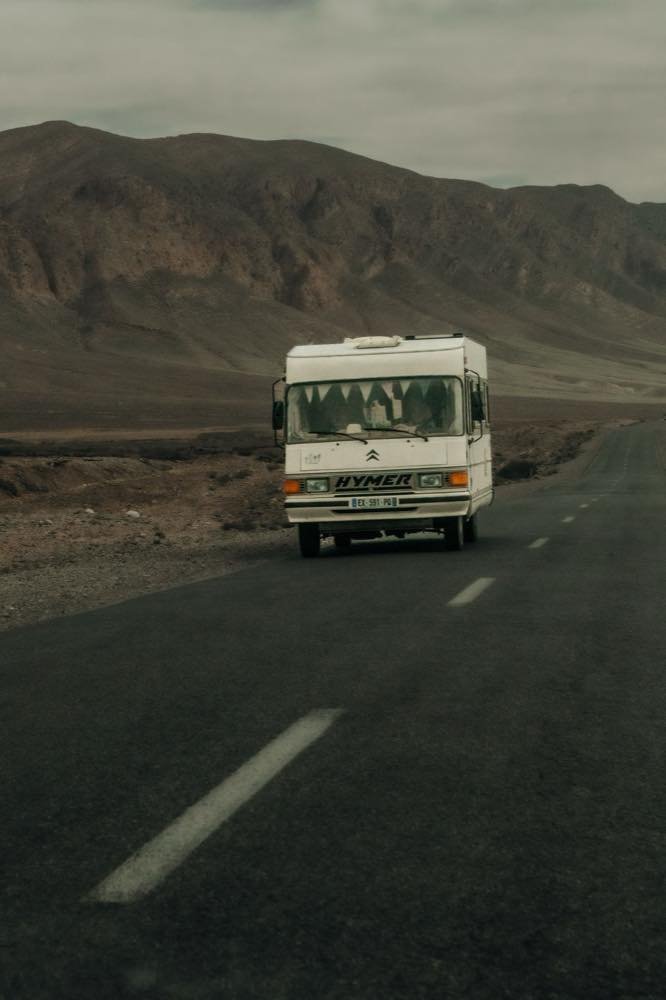
Two weeks is the right amount of time to drive Morocco’s Atlantic coast properly. You get five or six full surf days at Taghazout - enough to progress beyond the white water and start reading the break - followed by three nights in Imsouane where the longest rideable wave in Africa will reset every assumption you had about what surfing feels like, and then a final stretch in Essaouira, where the wind turns kite-flying into an obsession and the medina gives you something to do on the flat days.
This road trip runs Agadir to Essaouira in a hire car. The total driving distance is approximately 230 km, but you’ll put far more on the clock with the detours. It works for beginner and intermediate surfers. It also works for mixed groups where not everyone surfs - there is enough off the beach at each stop to fill the non-surf days without effort.
Before You Go
Flights: Fly into Agadir Al Massira Airport (AGA). Direct routes operate from most major European cities - London, Amsterdam, Paris, Madrid, Lisbon - via Ryanair, easyJet, Air Arabia Maroc, and Royal Air Maroc. Flight time from northern Europe is 3.5–4 hours. Search flights to Agadir on Aviasales and book early for the October to March peak season; fares rise sharply inside six weeks.
Hire car: Essential for this itinerary. Taghazout, Imsouane, and the coastal road between them are not well-served by public transport. Book a hire car at Agadir airport well in advance - peak-season desks have limited inventory and walk-up rates reflect that. Most international brands operate at AGA. A standard hatchback handles every road on this route. No 4WD needed.
Airport transfer: If you’d rather not drive on arrival day, book an airport transfer from AGA to your first night’s hotel and pick up the car the following morning. Kiwitaxi covers the AGA-Agadir and AGA-Taghazout routes reliably.
Travel insurance: Sort this before you leave home. VisitorsCoverage travel insurance covers Morocco including surf-related activities. The Atlantic swell is consistent and the breaks are rock-bottomed - insurance is not optional on a surf trip.
eSIM: Moroccan data SIMs are available at AGA arrivals, but coverage in Imsouane and the rural stretches is patchy. An Airalo Morocco eSIM loaded before you fly gives you data from the moment you land, without the arrivals-hall queue.
Best months: October through March for reliable swell and warm-ish water (18–22°C). November and December are the sweet spot: consistent Atlantic groundswell, uncrowded, manageable air temperatures. April and May work for less powerful surf and warmer days but lighter wind at Essaouira. July and August are hot, flat, and crowded - not the ideal surf trip.
The Route at a Glance
| Stop | Distance from previous | Nights |
|---|---|---|
| Agadir | - (fly in) | 1 |
| Taghazout | 20 km north | 6 |
| Imsouane | 80 km north | 3 |
| Essaouira | 70 km north | 3 |
| Agadir | 230 km south (fly out) | - |
Days 1–2: Agadir
Driving: 0 km (fly in).
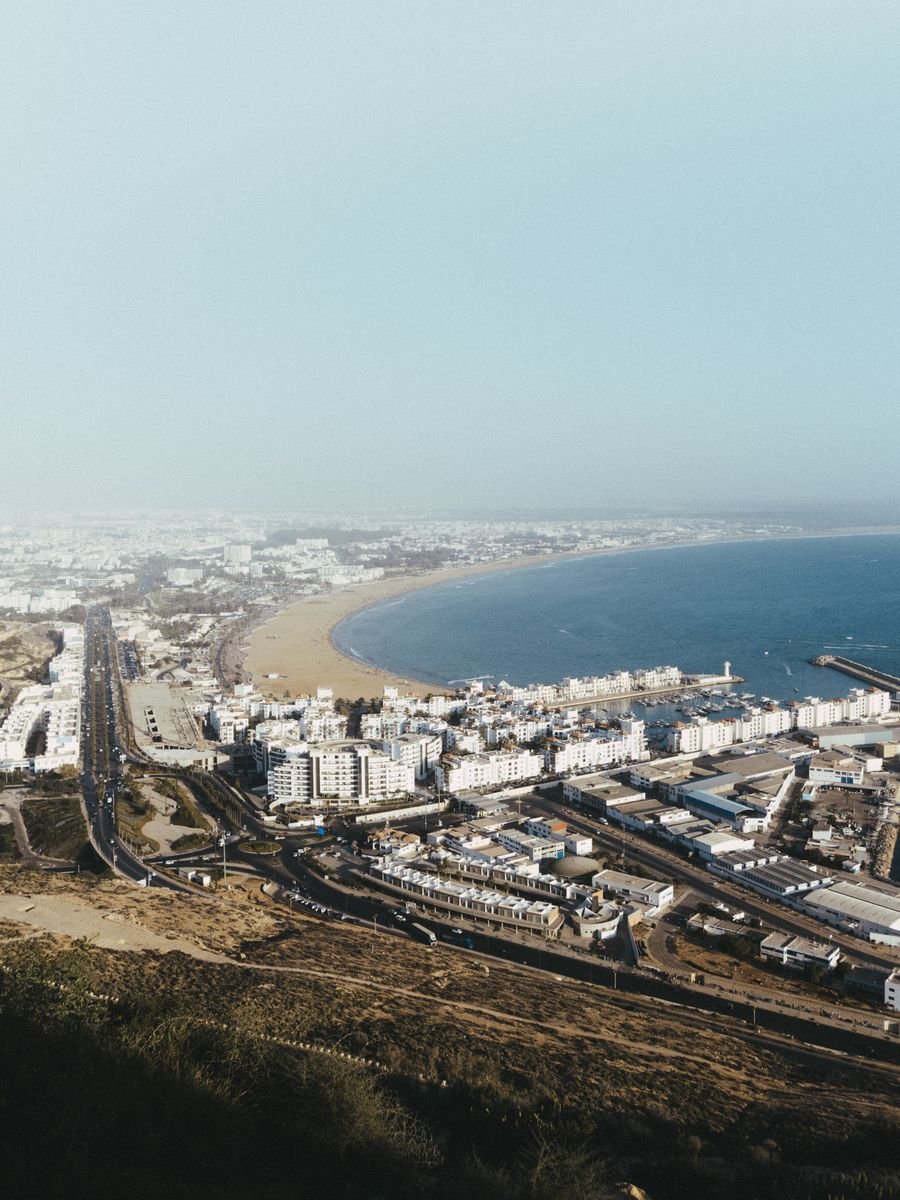 Agadir spreads along a long crescent bay, a simple first stop before the drive north.
Agadir is your landing pad, not a destination. That said, one night here before driving north makes sense - you land, you decompress, you eat something that isn’t airport food, and you pick up the hire car fresh the next morning rather than driving directly from arrivals into unfamiliar coast-road traffic.
The city is modern, beach-front, and well-organised by Moroccan standards. The bay runs for 10 km and faces south-west - sheltered from the dominant Atlantic swell, which makes the beach calm but uninteresting for surfing. That’s fine; you’re here to sleep and stock up.
Day 1: Land at AGA, take a private airport transfer to your hotel in Agadir or collect the hire car at the desk and drive into the city (15 minutes). Search accommodation in Agadir - the marina area or the beach boulevard puts you close to the restaurants. Eat argan-oil tagine at one of the medina restaurants, walk the corniche at sunset, sleep early.
Day 2: Collect the hire car if you haven’t already. Drive north on the N1 to Taghazout (20 km, approximately 20 minutes). On the way: if the swell is showing, pull over at Anza beach (5 km north of Agadir) and watch it for five minutes - this gives you your first read of the current conditions before you arrive.
Days 3–8: Taghazout
Driving: 20 km north of Agadir on the N1.
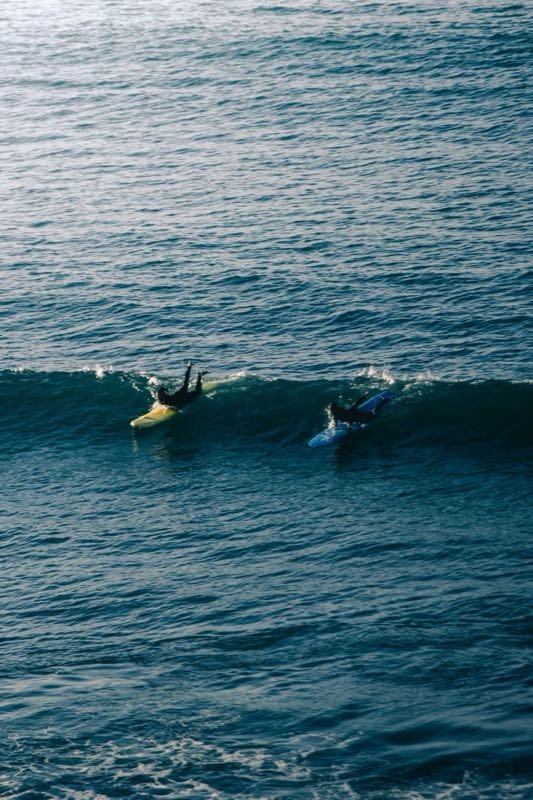 Atlantic swell is the reason this itinerary spends six nights on the Taghazout coast.
Six nights in Taghazout is the core of the trip. The village sits on a headland above a cluster of surf breaks that covers the full ability range - from the forgiving beach break at Panoramas for first-timers, up to the world-class right-hand point at Anchor Point for experienced surfers. You will not run out of breaks to explore in six days.
Search accommodation in Taghazout - options range from surf camps that bundle board hire, wetsuit, breakfast, and daily transfers to the break, through to private guesthouses in the village with rooftop terraces looking down at Hash Point. Surf camps simplify the logistics significantly for first-time visitors; guesthouses work better if you want flexibility over where you surf each day. See the full accommodation guide for Taghazout.
Day 3: First Surf Session
All abilities start at Panoramas - the beach break approximately 12 km south of Taghazout village, towards Agadir. It’s consistent, wide, and far more forgiving than the headland breaks. Book surf lessons in Taghazout at least two days in advance - the reputable schools fill in peak season. A two-hour lesson covers dry-land paddle technique, pop-up mechanics, wave selection, and water time. By the end of the session, most beginners have stood up on at least a few waves; most will fall off hundreds of times. Both outcomes are correct.
For intermediates: Panoramas works as a warm-up session after travel. Take the long board, focus on trimming rather than turning, and give your body 24 hours to adjust to the swell pattern before pushing into the headland breaks.
Day 4: Taghazout Headland Breaks
The headland above the village holds three distinct breaks in a 500-metre stretch: Hash Point at the base, Mysteries in the middle, and Anchor Point at the tip. Hash Point is a mellow right-hander that suits longboarders and intermediates; Mysteries has a longer, more workable face; Anchor Point is one of the best right-hand point breaks on the African continent - a long, powerful right that bends around the headland and produces rides of 200+ metres on a solid swell day. It breaks over reef and is not for beginners.
Check the swell chart before you drive up to Anchor. Anything below 1.5 m and it goes flat; anything above 3 m and it’s for experienced surfers only. The 1.5–2.5 m window is the sweet spot. The surf school and camp teams post morning conditions to their Instagram stories - worth checking at 7am before breakfast.
Day 5: Tamraght and Banana Point
Drive 3 km north to Tamraght (Aourir). The town is less surf-commercial than Taghazout and worth a wander: the main street has good hole-in-the-wall restaurants and a local market on weekday mornings. Banana Point in front of Tamraght is a beach break with a different character to Panoramas - shorter rides, more current, more challenge. Intermediates who want a contrast from the point breaks should come here.
Afternoon option: Paradise Valley. The gorge is 40 minutes inland from Tamraght on the Imouzzer road. Swim in the rock pools, eat under the palms, return in time for sunset. Book the guided half-day Paradise Valley trip at approximately 35–45 EUR per person including transport, or drive yourself (the road is paved and clearly signposted).
Day 6: Surf School Comparison Day
By day four in the water, most beginners are ready to try a different instructor or school to get a fresh set of eyes on their technique. Taghazout has excellent schools - see the surf schools comparison for a breakdown of what each one offers and at what price point. A second round of lessons from a different coach accelerates progression faster than repeating the same session. Book surf packages in Taghazout if you want to lock in multiple days at a reduced rate.
Days 7–8: Free Surf and Rest
Two days without structure. Surf what you want, when you want. Anchor Point on a morning swell; Hash Point in the afternoon; a flat-day walk to Boilers on the point below the village. If your arms are cooked from five days of paddling, take day 7 as a rest day - the Atlantic will still be there tomorrow.
Eat well: the village has several good roof-terrace restaurants serving fresh fish, merguez, and tagines. Order the fish - it came off a boat this morning.
Days 9–11: Imsouane
Driving: 80 km north of Taghazout on the N1, approximately 1 hour.
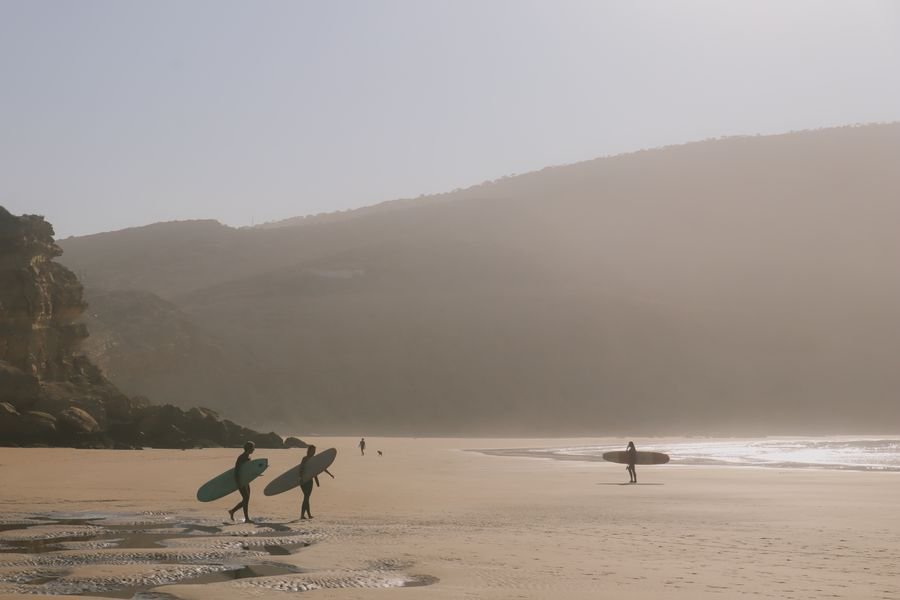 Imsouane in the late afternoon, when the bay empties and the light turns gold.
Imsouane is the reason serious surfers add this leg to the trip. The village sits at the head of a large, south-facing bay that produces The Bay wave - a slow, mellow right-hander that on a good day produces rides of 300–800 metres. It is one of the longest rideable waves in Africa. You paddle once, stand up, and then ride for longer than seems physically possible. It resets your understanding of what surfing feels like.
The second break, The Cathedral, is a faster, more powerful left that breaks around the southern headland of the bay. It’s steeper and more technical than The Bay, and suits intermediate-to-advanced surfers. The combination of both breaks in one bay means you can surf both in the same session.
The village itself is small - fishing port, a handful of surf camps and guesthouses, a few restaurants serving fresh catch at remarkably low prices. It is quieter than Taghazout and noticeably more local in character. Most visitors stay two nights; three is better.
Search accommodation in Imsouane. Options are limited compared to Taghazout - book ahead. The surf camps above the bay (Surf Maroc and Imsouane Village Surf Camp are consistently well-reviewed) include board and breakfast, which is worth the premium given the limited dining options. See the Imsouane accommodation guide.
Surf conditions: Imsouane needs a north-west or west swell with 1.5 m+ height to fire properly. A southerly swell wraps poorly. The bay is most consistent from October to March, with November through February producing the most reliable groundswell windows.
Day 9: Drive up from Taghazout in the morning. Check in. Walk the port. Watch the bay for the afternoon and get a read on the break before you paddle out. The Bay rewards patience - watch where the better surfers are sitting, watch where the wave bends, and choose your spot on the takeoff accordingly.
Day 10: Full day at The Bay. This is what you came for. Rent a longboard if you don’t have one - The Bay is a longboard wave, and trying it on a shortboard misses the point. Paddle out early (7–8am) before the onshore wind builds. Two sessions: morning before wind, afternoon after the wind drops (typically from 4pm). Eat fresh grilled sardines at the port restaurant for under 5 EUR. Sleep well.
Day 11: Morning session at The Cathedral (intermediates and above). Afternoon: drive 30 km north on the P2015 to Tamri, where the Oued Tamri river mouth meets the sea - a reliable left-hander over a sand bottom that is more forgiving than The Cathedral. Flamingos occasionally appear on the river mud flats. Return to Imsouane for the last night.
Days 12–14: Essaouira
Driving: 70 km north of Imsouane on the P2015/N1, approximately 1 hour.
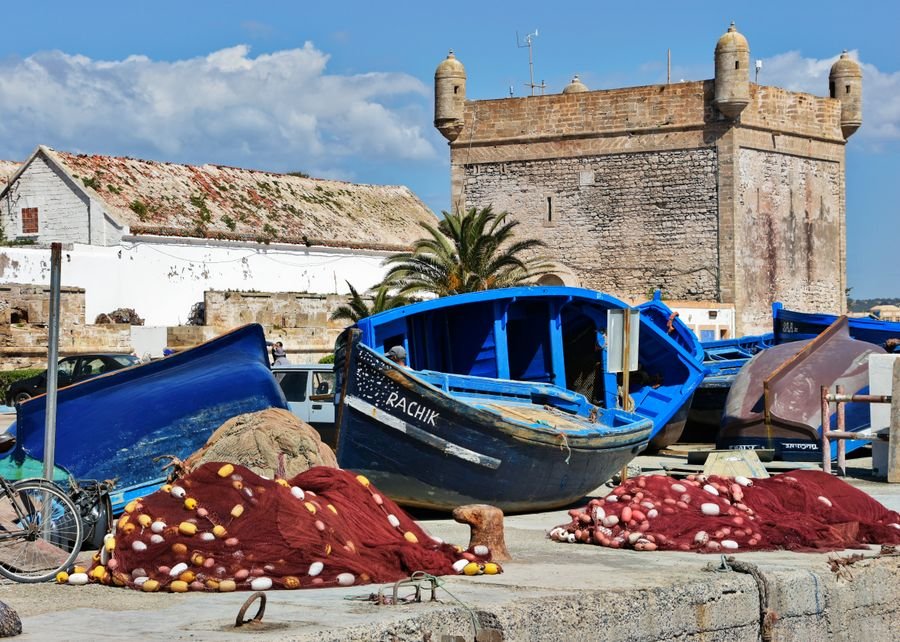 The Essaouira harbour and sea bastion, a short walk from the medina gate.
Essaouira changes the tone of the trip. The walled Atlantic city is a UNESCO World Heritage Site - blue-and-white ramparts, a medina of narrow alleys, a working fishing port, argan oil markets, and a near-permanent 25-knot wind that makes it the kitesurfing capital of North Africa. The waves are often blown out by the same wind, which makes Essaouira a semi-surfing destination: catch it early before the wind builds, or accept that you’re here for the culture and the kite watching.
Search accommodation in Essaouira - the old medina has several well-preserved riads at reasonable prices, with rooftop terraces looking out over the ramparts and sea. Book ahead; the better properties fill fast. See the Essaouira accommodation guide.
Day 12: Drive north from Imsouane. The P2015 coastal road is scenic - argan forest, glimpses of sea, a few fishing hamlets. Arrive in Essaouira, check in, walk the ramparts at the southern end of the medina (the Skala de la Ville - open until 6pm, entry approximately 10 MAD), and watch the Atlantic from the cannon platform. Fish dinner at the port - grilled swordfish, sea bream, or the local speciality of spiced calamari. Prices at the port stalls are fixed and very reasonable.
Day 13: Surf early (7–8am before the wind builds) at Diabat beach, 3 km south of the medina. The wave is a beach break that works best in smaller swell and is forgiving by local standards - the Essaouira surf conditions are dependent on timing. By 10am, the famous Alizée trade wind picks up to 20–30 knots and the sea becomes a kitesurf playground. Spend the afternoon at the medina: the spice market, the marquetry workshops on Rue Laalouj, the Sidi Mohammed Ben Abdallah museum, and the ramparts walk at sunset. Gnawa musicians often play near Bab Doukkala in the early evening.
Day 14: Final morning. If swell is running, one last session at Diabat. Then drive south - Agadir airport is approximately 230 km and 2.5 hours via the N1. Allow extra time for traffic south of Agadir. Return the hire car at AGA with a full tank, collect your board bag from the boot, and fly home.
Packing for the Surf Road Trip
Surfboard: A hire car comfortably fits two longboards or three shortboards on the back seat with the seat folded. Strapping to a roof rack is possible but requires a specialist rack. Most surf camps and shops at each stop rent boards at 100–200 MAD per day - renting locally is often simpler than travelling with your own.
Wetsuit: 3/2 mm full suit for November through February; 2 mm short arm for March through May; boardshorts for summer. The Atlantic water temperature at Taghazout averages 19°C in winter, 23°C in summer.
Sun protection: The Moroccan sun is strong even in winter. 50+ reef-safe sunscreen, rashguard, and a hat.
Cash: Morocco runs on cash for markets, port restaurants, surf lessons, and tipping. There are ATMs in Agadir and Essaouira; Imsouane has none - withdraw before you arrive. See the ATM and cash guide for Taghazout.
Budget Guide
These figures cover two people sharing accommodation, sharing a hire car, and surfing every day. Prices are approximate and as of 2026.
| Item | Budget per person / day |
|---|---|
| Budget surf camp (meals included) | 40–60 EUR |
| Mid-range guesthouse + eating out | 55–80 EUR |
| Boutique riad (Essaouira) | 70–110 EUR |
| Surf lessons (group, 2 hours) | 20–35 EUR |
| Hire car (split 2 ways) | 12–20 EUR |
| Meals (lunch + dinner, eating locally) | 15–25 EUR |
| Travel insurance (full trip) | 30–60 EUR total |
Rough two-week total per person: 1,200–2,000 EUR excluding flights, depending on how much you eat out and whether you take guided tours.
Surf Level Guide
Total beginners: Panoramas (Taghazout) for days 1–3; The Bay at Imsouane from day 8. Both are forgiving sand-bottom or mellow point breaks. Book at least three lessons with a qualified instructor before free surfing. Avoid Anchor Point, The Cathedral, and Diabat in any swell above 1.5 m until you are consistently riding open-face waves.
Intermediates: Anchor Point (1.5–2.5 m swell), Hash Point (all swell sizes), Banana Point (Tamraght), The Bay longboard sessions, The Cathedral on smaller days. Essaouira’s Diabat beach in clean conditions before wind.
Advanced: Anchor Point in 2.5 m+ swell, Killers (the break 2 km north of Anchor Point), Tamri point, The Cathedral in solid swell. Killers surf guide for conditions and access.
Getting There and Back
Flights from the UK: Ryanair and easyJet operate direct London Stansted/Gatwick to AGA from approximately 60–150 EUR return in shoulder season. Royal Air Maroc operates via Casablanca. Search and compare flights.
Airport transfers: Book an airport transfer from AGA for arrival and departure if you don’t want to drive on the first or last day.
Hire car: GetRentacar at Agadir airport - book the full 14-day period; one-way rentals (pick up Agadir, drop Essaouira) are available but carry a surcharge.
Travel insurance: VisitorsCoverage Morocco surf cover - confirm the policy includes water sports and medical repatriation before you book.