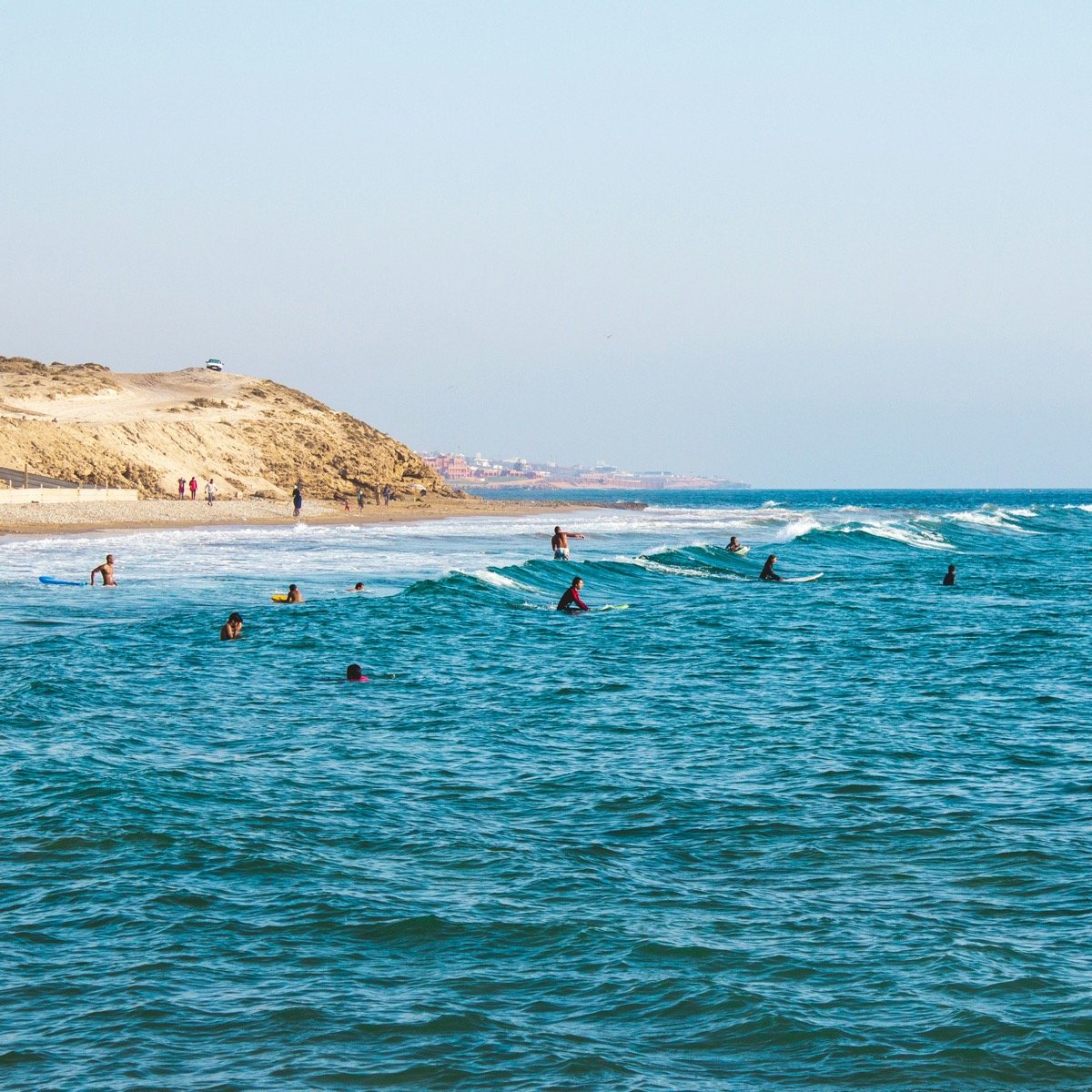
The Atlantic swell that reaches Taghazout originates in the North Atlantic low-pressure systems far to the northwest. By the time it arrives on this stretch of Moroccan coastline, it has typically organised into long, clean lines - ideal for the point breaks that define this area. What you get depends entirely on when you show up.
The Swell Window
Taghazout sits at roughly 30°N on the Atlantic-facing Moroccan coast. That position means it picks up long-period North Atlantic groundswell from September through April, with the peak of the swell season running December through February. In summer, the North Atlantic high-pressure system dominates and suppresses swells - the coast goes flat or midsummer.
The dominant swell direction is NW (300–330°), which is why Anchor Point, Hash Point, and Killers - all angled to receive this direction - are the benchmark spots. The odd westerly or SW swell brings life to beach breaks at Tamraght and Taghazout village, but the quality points need NW.
Wind is the other variable. A northeast trade wind (Alizé) blows offshore on the main point breaks much of the year, particularly in the mornings. The afternoon often sees onshore wind creeping in from the west. In summer, the Alizé strengthens considerably - the coast becomes a kitesurf destination, not a surf destination.
Month-by-Month Breakdown
| Month | Avg Swell Size | Swell Period | Wind | Water Temp | Notes |
|---|---|---|---|---|---|
| January | 1.5–2.5m | 14–18s | NE offshore am | 18°C | Peak season, heavy and consistent |
| February | 1.5–2.5m | 14–18s | NE offshore am | 17°C | Best quality of the year, crowded |
| March | 1–2m | 12–16s | Variable | 17°C | Still solid, crowds thinning |
| April | 0.8–1.5m | 12–14s | Light variable | 18°C | Great for intermediate surfers |
| May | 0.6–1.2m | 10–14s | SW increasing | 19°C | Smaller and cleaner, fewer crowds |
| June | 0.3–0.8m | 8–12s | Strong SW/NW | 20°C | Mostly flat, strong winds |
| July | 0.2–0.6m | 8–10s | Strong NW Alizé | 21°C | Flat - kite season, not surf season |
| August | 0.2–0.6m | 8–10s | Strong NW Alizé | 22°C | As above |
| September | 0.5–1m | 10–14s | Variable | 22°C | Swell building, warm water |
| October | 0.8–1.5m | 12–16s | NE offshore am | 21°C | Excellent all-round conditions |
| November | 1–2m | 14–18s | NE offshore am | 19°C | Swell building quickly, less crowded |
| December | 1.5–2.5m | 14–18s | NE offshore am | 18°C | Full peak season begins |
Swell sizes refer to face height. Water temperatures are approximate averages as of 2026.
Best Months for Beginners
April, May, September, October are the windows for first-time and beginner surfers.
Swell is typically 0.8–1.5m - manageable for learning - with longer periods between sets. Wind is lighter compared to summer and generally offshore in the mornings. Surf schools in Taghazout and Tamraght run full programmes during these months.
September is particularly good: the water is still warm (21–22°C) from summer, swell starts to arrive, and the crowds from peak season haven’t materialised yet. Expect to pay 250–400 MAD for a group lesson including board and wetsuit hire.
Avoid November through February as a complete beginner. Anchor Point and Hash Point are running at full force, the water is colder, and the rip currents are more powerful.
Best Months for Advanced Surfers
November through March is when Taghazout delivers its best surf.
Anchor Point at 2m+ on a long 16-second NW swell is one of the most enjoyable right-hand point breaks in the Atlantic. The wave walls up along the point for 200–400 metres, offering multiple sections. December and January see the most consistent run of solid swell, with surf camp calendars filling up months in advance.
February is arguably the peak month: swell from North Atlantic lows is still powerful, the wind is generally manageable, and the light - low in the sky in the northern hemisphere winter - is extraordinary for surfing and photography.
Advanced surfers should also check Killers (big paddle-out in solid NW swell) and Boilers (hollow, short, very heavy when it’s on). Both need real size and a specific swell direction to work.
Wind Pattern
The northeast trade wind (Alizé) blows offshore on the main point breaks in Taghazout. It’s one of the reasons the surf quality is consistently good compared to more exposed coasts - the wind grooms the swell rather than chopping it up.
Mornings are almost always better than afternoons. By midday, particularly in spring and autumn, an onshore sea breeze often develops. Early sessions at Anchor Point in peak season start at first light.
In summer, the Alizé strengthens to 20–30 knots or more, which is why the Souss-Massa coast north of Agadir is a kitesurfing hub from June to August. For surfers, this means onshore chop and minimal swell - not the season to come for waves.
Water Temperature and Wetsuits
| Season | Water Temp | Recommended Wetsuit |
|---|---|---|
| December–February | 17–18°C | 4/3mm fullsuit |
| March–May | 17–19°C | 3/2mm fullsuit |
| June–August | 20–22°C | 2/2mm shorty or boardshorts |
| September–November | 20–22°C → 18°C | 2/2mm to 3/2mm |
The water is cold by tropical standards but mild compared to mainland Europe. A 3/2mm covers most of the year; upgrade to 4/3mm for December–February early morning sessions. Boots and gloves are rarely needed.
Most surf camps and rental shops in Taghazout stock 3/2mm and 4/3mm wetsuits for hire at 50–80 MAD per day.
Crowds
Taghazout’s surf has a global reputation now, and the lineup at Anchor Point in peak season is genuinely busy. Expect 40–80 surfers on a good day in December–February. Experienced surfers know that early mornings before 8am, and late afternoons after 5pm, are significantly less crowded.
The October–November and March–April shoulder windows offer a reasonable compromise: swell is present, quality is good, and crowds are noticeably thinner. If lining up for a wave at Anchor Point next to 60 other surfers is going to frustrate you, shoulder season is the call.
Less-known spots - Banana Point, Panoramas, Mysteries - see a fraction of the crowd compared to Anchor Point and Hash Point even in peak season. The trade-off is that they need more specific swell and wind to work well.
What to Book in Advance
Surf camps in Taghazout and Tamraght fill up fast for peak season (November–February). If you’re planning a December or February trip, book accommodation two to three months ahead. April and October are easier - a week’s notice is usually sufficient for most guesthouses.
Surf lessons in Taghazout are worth booking before you arrive in peak season — school slots fill up quickly in December and January, and pre-booking guarantees your session time and equipment. For those arriving without a camp package, gyg surf lesson and practice sessions run from the village most mornings.
Board hire is available throughout the season: shortboards, longboards, and mid-lengths are all available from shops in Taghazout and Tamraght at 80–150 MAD per day.
Anchor Point surf guide - the best right-hander in Morocco Hash Point - the beginner-friendly option in the Taghazout lineup Taghazout surf forecast guide — apps, swell windows and how to read conditions Surf instructors and lessons in Taghazout Surfboard hire in Taghazout and Tamraght